Pages

THE BUZZARD IN EXTREMADURA (2009-2010)

Buzzard (Buteo buteo). By José Ledo.

The Buzzard (Buteo buteo) was another one of the target species in the SEO/BirdLife-brokered national woodland raptor survey 2009-2010 (Palomino and Valls, 2011). The estimated Extremadura population came out as 2870 territories (range 2790-2960). This represents 9.3% of the Spanish total (31,000 territories), coming in fourth behind three bigger regions: Castilla y León (5530), Andalucía (5520) and Castilla-La Mancha (3900). Extremadura's average density is 6.9 territories per 100 km2, a little above the national mean (6.1) but behind the Canary Islands (16) and the Cantabrian coast (9.5).

Cáceres, with an estimated 1490 territories, boasts Spain's biggest provincial population, followed by Badajoz with 1380 territories. Since both provinces are so big, the density (7.5 and 6.3 respectively) is lower than many other provinces, ranking 12th and 22nd respectively.

The Buzzard's range takes in the whole of Extremadura. It is most frequent in the province of Cáceres and thins out only in the Sierra de Gata, Las Hurdes, Las Villuercas and the southeast corner of the province. In Badajoz the best areas are in the northern third, near the River Guadiana, numbers dying down towards the south of the province. In Extremadura it was detected in 60% of the surveyed grids. The Buzzard is a very versatile raptor that can take to many different types of habitat. In general it prefers low- or medium-altitude areas that are not too hot and with a patchwork mixture of farmland, deciduous woods and Holm-Oak woods. It prefers high rainfall in hotter climes and low rainfall in colder areas.

Predictive map of the Buzzard's range in Spain, taken from Palomino and Valls (2011).

The car transects in Extremadura threw up an average of 6.3 birds every 100 km (6.8 in Badajoz and 5.8 in Cáceres); it was observed in 85% of the surveyed grids. Spain's mean birds-per-kilometre figure was 6.8, with Salamanca (19.2), Cantabria (17.9) and Ávila (14.9) to the fore.

The Buzzard's trend in Spain is stable according to the breeding birds monitoring project SACRE, especially in the centre of the country, including Extremadura.

The fieldwork was coordinated and carried out by SEO volunteers and staff of the Environment Board of the Regional Council of Extremadura.

Source:
- Palomino, D., and Valls, J. 2011. Las rapaces forestales en España. Población reproductora en 2009-2010 y método de censo. SEO/BirdLife. Madrid. [PDF]

Buzzard (Buteo buteo). By José Ledo.

The Buzzard (Buteo buteo) was another one of the target species in the SEO/BirdLife-brokered national woodland raptor survey 2009-2010 (Palomino and Valls, 2011). The estimated Extremadura population came out as 2870 territories (range 2790-2960). This represents 9.3% of the Spanish total (31,000 territories), coming in fourth behind three bigger regions: Castilla y León (5530), Andalucía (5520) and Castilla-La Mancha (3900). Extremadura's average density is 6.9 territories per 100 km2, a little above the national mean (6.1) but behind the Canary Islands (16) and the Cantabrian coast (9.5).

Cáceres, with an estimated 1490 territories, boasts Spain's biggest provincial population, followed by Badajoz with 1380 territories. Since both provinces are so big, the density (7.5 and 6.3 respectively) is lower than many other provinces, ranking 12th and 22nd respectively.

The Buzzard's range takes in the whole of Extremadura. It is most frequent in the province of Cáceres and thins out only in the Sierra de Gata, Las Hurdes, Las Villuercas and the southeast corner of the province. In Badajoz the best areas are in the northern third, near the River Guadiana, numbers dying down towards the south of the province. In Extremadura it was detected in 60% of the surveyed grids. The Buzzard is a very versatile raptor that can take to many different types of habitat. In general it prefers low- or medium-altitude areas that are not too hot and with a patchwork mixture of farmland, deciduous woods and Holm-Oak woods. It prefers high rainfall in hotter climes and low rainfall in colder areas.

Predictive map of the Buzzard's range in Spain, taken from Palomino and Valls (2011).

The car transects in Extremadura threw up an average of 6.3 birds every 100 km (6.8 in Badajoz and 5.8 in Cáceres); it was observed in 85% of the surveyed grids. Spain's mean birds-per-kilometre figure was 6.8, with Salamanca (19.2), Cantabria (17.9) and Ávila (14.9) to the fore.

The Buzzard's trend in Spain is stable according to the breeding birds monitoring project SACRE, especially in the centre of the country, including Extremadura.

The fieldwork was coordinated and carried out by SEO volunteers and staff of the Environment Board of the Regional Council of Extremadura.

Source:
- Palomino, D., and Valls, J. 2011. Las rapaces forestales en España. Población reproductora en 2009-2010 y método de censo. SEO/BirdLife. Madrid. [PDF]

reade more... Résuméabuiyad

Nice Day

After yesterdays dismal ringing with 3 sites visited in 8 hours and 1 Linnet Ringed
today proved to be a lot better. I went down to Port Mooar and was met by over 50 Rock Pipits on the seaweed. I set up a few spring traps and caught 6 birds in an Hour. 4 new and 2 retraps. Also was able to read another 5 ringed birds.
First ringed 04 November 2010

Ringed today

First Ringed July 28 2011
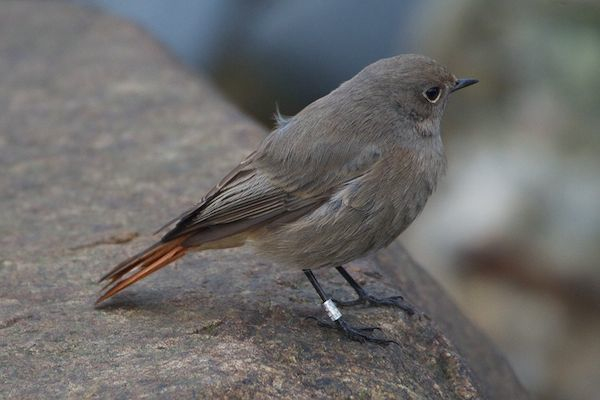
I left Port Mooar and headed home for a coffee. I decided to go to Ramsey harbour and try for Rock Pipits there. I got there at 1pm set 3 traps and put on Rock Pipit call as i walked back to the car a bird flew past me and landed by the first spring trap i got my camera on it and rattled 2 shots off. A Black Redstart was sat on the side of the spring trap, 10 seconds later it was in.


Cracking bird still showing well  at 3:30 

When i got home i got a email off Kev to say another of our LBBG had been sighted this time in 
Quarteira Harbour, Portugal on the 16th November 2011 by Gordon Avery

X89:M was ringed at The Gravel Pits on 1 July this year as a Chick {Pulli}
only 11 LBBG Gulls colour ringed by us this year and 3 have been seen in Spain and 1 in Portugal
just shows how well these colour rings work and a big thank you to all the guys who go out and look for them as well
Nice end to a great day


X89:M SHOWING RING ON LEFT
After yesterdays dismal ringing with 3 sites visited in 8 hours and 1 Linnet Ringed
today proved to be a lot better. I went down to Port Mooar and was met by over 50 Rock Pipits on the seaweed. I set up a few spring traps and caught 6 birds in an Hour. 4 new and 2 retraps. Also was able to read another 5 ringed birds.
First ringed 04 November 2010

Ringed today

First Ringed July 28 2011
I left Port Mooar and headed home for a coffee. I decided to go to Ramsey harbour and try for Rock Pipits there. I got there at 1pm set 3 traps and put on Rock Pipit call as i walked back to the car a bird flew past me and landed by the first spring trap i got my camera on it and rattled 2 shots off. A Black Redstart was sat on the side of the spring trap, 10 seconds later it was in.


Cracking bird still showing well  at 3:30 

When i got home i got a email off Kev to say another of our LBBG had been sighted this time in 
Quarteira Harbour, Portugal on the 16th November 2011 by Gordon Avery

X89:M was ringed at The Gravel Pits on 1 July this year as a Chick {Pulli}
only 11 LBBG Gulls colour ringed by us this year and 3 have been seen in Spain and 1 in Portugal
just shows how well these colour rings work and a big thank you to all the guys who go out and look for them as well
Nice end to a great day


X89:M SHOWING RING ON LEFT
reade more... Résuméabuiyad

Last week update

A quite week last week with birds ringed being  
2 Greenfinch
11 Goldfinch
28 Linnet
2 Blue Tits
1 Chaffinch
1 Robin
2 Blackbirds
4 Herring Gulls
2 Black Headed Gulls

Retraps LAST WEEK

Coal Tit (7) 1 bird first ringed 28/08/2009
Blue Tit (5)
Gt Tit (2)
Chaffinch (2)
Linnet (2) 1 bird was in the first catch i did back on 24/08/2010 

I was out with Chris and Kay on Saturday morning another 58 new birds ringed at the Sulby feeder site
retraps =( )

8 Coal Tit  (3)
8 Greenfinch
22 Blue Tits (10)
4 Chaffinch
10 Gt Tits (5)
3 House Sparrow
2 Robin
1 Dunnock (1)
1 Blackbird


A quite week last week with birds ringed being  
2 Greenfinch
11 Goldfinch
28 Linnet
2 Blue Tits
1 Chaffinch
1 Robin
2 Blackbirds
4 Herring Gulls
2 Black Headed Gulls

Retraps LAST WEEK

Coal Tit (7) 1 bird first ringed 28/08/2009
Blue Tit (5)
Gt Tit (2)
Chaffinch (2)
Linnet (2) 1 bird was in the first catch i did back on 24/08/2010 

I was out with Chris and Kay on Saturday morning another 58 new birds ringed at the Sulby feeder site
retraps =( )

8 Coal Tit  (3)
8 Greenfinch
22 Blue Tits (10)
4 Chaffinch
10 Gt Tits (5)
3 House Sparrow
2 Robin
1 Dunnock (1)
1 Blackbird


reade more... Résuméabuiyad

THE SHORT-TOED EAGLE IN EXTREMADURA (2009-2010)

Short-Toed Eagle (Circaetus gallicus). Eva Palacios.

The Short-Toed Eagle (Circaetus gallicus) was another one of the target species in the SEO/BirdLife-brokered national woodland raptor survey 2009-2010 (Palomino and Valls, 2011). The estimated Extremadura population came out as 980 territories (range 940-1020). This represents 9.4% of the Spanish total (10,380 territories), ranking fifth behind the bigger regions of Castilla-La Mancha (1800), Castilla y León (1760), Andalucía (1620) and Aragón (1340). Extremadura's mean density is 2.4 territories per 100 km2, above the national average of 2.1 and behind only Aragón (2'8) and the Valencia Region (2.7).

Cáceres, with an estimated 570 territories, boasts Spain's biggest provincial population, albeit ranking fourth in density (2.87 territories per 100 km2) behind Castellón, Teruel and Guadalajara. Badajoz, for its part, accounts for 410 territories, 1.88 every 100 km2 (the 30th highest density in Spain).

The Short-Toed Eagle ranges widely over the whole of Extremadura. It is especially abundant in the eastern half of Cáceres and the northeast corner of Badajoz, the two areas with the highest sighting probability in the whole of Spain. Although it is less common in the province of Badajoz, especially in its western half, some parts of the province still throw up the highest one-off densities in the whole of Spain (2.5 territories in only 10 km2). In all it was detected in 41% of the surveyed 10k grids. In Spain the Short-Toed Eagle favours low-altitude, high insolation areas with extensive Holm Oak woods, warm but with a certain humidity and little farmland.

Predictive map of the Short-Toed Eagle's (Circaetus gallicus) range in Spain, taken from Palomino and Valls (2011). This clearly shows that the eastern half of Cáceres offers the highest likelihood of a Short-Toed Eagle sighting.

On the Extremadura car transects 2.5 birds were seen every 100 km; it tuned up in 65% of the sampled grids. The mean birds-per-kilometre figure for Spain as a whole was 1.6, led by Castellón (4.4), La Rioja (2.8), Ciudad Real (2.8), Badajoz (2.7), Segovia (2.7) and Cáceres (2.4).

The Short-Toed Eagle's trend in Spain is stable according to the breeding birds monitoring project SACRE, although migration figures across the Strait of Gibraltar increased at an annual rate of 6.6% over the 1998-2009 period. Given that Spain's population is the biggest in Europe, it is logical to conclude that it is on the increase; this is born out by comparing the birds-per-kilometre figure with previous studies.

Not much can be added to the SEO/BirdLife results. The apparent discrepancy between the different surveying methods (for example, Cáceres is the province with the highest sighting rate from lookout points but only the sixth in car transects) is only to be expected in samples where the zones visited might be different and there are also several factors that might muddy the subsequent analysis (low territoriality, territory overlaps and shared hunting grounds).

The fieldwork was coordinated and carried out by SEO volunteers and staff of the Environment Board of the Regional Council of Extremadura.

Source:
- Palomino, D., and Valls, J. 2011. Las rapaces forestales en España. Población reproductora en 2009-2010 y método de censo. SEO/BirdLife. Madrid [PDF]
Short-Toed Eagle (Circaetus gallicus). Eva Palacios.

The Short-Toed Eagle (Circaetus gallicus) was another one of the target species in the SEO/BirdLife-brokered national woodland raptor survey 2009-2010 (Palomino and Valls, 2011). The estimated Extremadura population came out as 980 territories (range 940-1020). This represents 9.4% of the Spanish total (10,380 territories), ranking fifth behind the bigger regions of Castilla-La Mancha (1800), Castilla y León (1760), Andalucía (1620) and Aragón (1340). Extremadura's mean density is 2.4 territories per 100 km2, above the national average of 2.1 and behind only Aragón (2'8) and the Valencia Region (2.7).

Cáceres, with an estimated 570 territories, boasts Spain's biggest provincial population, albeit ranking fourth in density (2.87 territories per 100 km2) behind Castellón, Teruel and Guadalajara. Badajoz, for its part, accounts for 410 territories, 1.88 every 100 km2 (the 30th highest density in Spain).

The Short-Toed Eagle ranges widely over the whole of Extremadura. It is especially abundant in the eastern half of Cáceres and the northeast corner of Badajoz, the two areas with the highest sighting probability in the whole of Spain. Although it is less common in the province of Badajoz, especially in its western half, some parts of the province still throw up the highest one-off densities in the whole of Spain (2.5 territories in only 10 km2). In all it was detected in 41% of the surveyed 10k grids. In Spain the Short-Toed Eagle favours low-altitude, high insolation areas with extensive Holm Oak woods, warm but with a certain humidity and little farmland.

Predictive map of the Short-Toed Eagle's (Circaetus gallicus) range in Spain, taken from Palomino and Valls (2011). This clearly shows that the eastern half of Cáceres offers the highest likelihood of a Short-Toed Eagle sighting.

On the Extremadura car transects 2.5 birds were seen every 100 km; it tuned up in 65% of the sampled grids. The mean birds-per-kilometre figure for Spain as a whole was 1.6, led by Castellón (4.4), La Rioja (2.8), Ciudad Real (2.8), Badajoz (2.7), Segovia (2.7) and Cáceres (2.4).

The Short-Toed Eagle's trend in Spain is stable according to the breeding birds monitoring project SACRE, although migration figures across the Strait of Gibraltar increased at an annual rate of 6.6% over the 1998-2009 period. Given that Spain's population is the biggest in Europe, it is logical to conclude that it is on the increase; this is born out by comparing the birds-per-kilometre figure with previous studies.

Not much can be added to the SEO/BirdLife results. The apparent discrepancy between the different surveying methods (for example, Cáceres is the province with the highest sighting rate from lookout points but only the sixth in car transects) is only to be expected in samples where the zones visited might be different and there are also several factors that might muddy the subsequent analysis (low territoriality, territory overlaps and shared hunting grounds).

The fieldwork was coordinated and carried out by SEO volunteers and staff of the Environment Board of the Regional Council of Extremadura.

Source:
- Palomino, D., and Valls, J. 2011. Las rapaces forestales en España. Población reproductora en 2009-2010 y método de censo. SEO/BirdLife. Madrid [PDF]
reade more... Résuméabuiyad

SANDHILL CRANE. FIRST FOR EXTREMADURA AND SPAIN

Manuel Gómez Calzado, without doubt the person with most crane-watching hours behind him in Extremadura, has reported the sighting of a Sandhill Crane (Grus canadensis) in his personal blog (grullas veo). The bird was seen on 4 November 2011 grazing stubble in a flock of ten Common Cranes (Grus grus) on the estate called Don Benito between Torviscal and Palazuelo (Badajoz). He explains in the blog entry that the bird was only about 200 metres away, the visibility was perfect and he was able to take in all the plumage details for about 5 minutes: clearly smaller in size than the Common Cranes alongside, a paler grey colour overall, a bright red bald patch on the crown, no black in the neck and dark patches on the wing coverts, a characteristic of this bird's winter plumage. When it took flight its smaller size again stood out against its bigger cousins. This description suggests that it was not a young bird. Manolo Gómez returned to the area on following days but could not relocate the bird. After word of the finding got out, other birders flocked to the area but no one had any luck as far as we know. Although it's a bit like looking for a needle in a haystack, there's a lot of winter left for looking, so there is still hope.

Sandhill Crane (Grus canadensis) photographed in United States by Ron Flemal (taken from IBC).

Unfortunately there are no photos of the Extremadura bird. If accepted by the rarities committee it will be the first record for Extremadura and Spain.

After a quick trawl through the Net in search of info we have come up with the following list of former sightings in Europe:
- Cork, Ireland (killed by hunters on 14/09/1905)
- Faroe Isles (one adult on 14/10/1980)
- Fair Isles, Shetland, Scotland (one juvenile on 26/04/1980)
- Shetland Isles, Scotland (one juvenile on 25 and 26/09/1991); this bird then moved on to Holland (17-26/09/1991; the firs record on mainland Europe)
- Flores Isles, Azores, Portugal (one juvenile from 26/06 to 03/07/2000)
- Orkney Isles, Scotland, (one adult, 22-29/09/2009)
- Les Landes, Southwest France (one adult on 11/10/2009). Might be the one seen earlier in Scotland. Hopes were harboured that it might move on to Spain but it was never seen here.
- Finland (one adult, 05/09/2011)
- Estonia (the former bird; 06-08/09/2011)
- Scotland (one 2nd-winter bird on 22-26/09/11 in Aberdeenshire, and then maybe the same bird in England 29/09 to 07/10/2011 in Northumberland). This might be the same bird that has turned up in Extremadura.

This means that, with the latest Badajoz sighting, there have only been 12 Sandhill Cranes seen in Europe, four of them in 2011. Our heartfelt congratulations therefore go out to Manolo Gómez Calzado for this memorable find, just reward or so many years watching his beloved cranes in the field. Note also that Manolo was the first person to see a Demoiselle Crane (Grus virgo) in Spain, from 4 to 14 February 1996 in Navalvillar de Pela (Badajoz), later seen on 7-8 March in Gallocanta. In this case a feral bird cannot be ruled out. In any case it was the first accepted record of a Demoiselle Crane in Spain, a species that bred in the past, with the last Iberian records in Badajoz back in 1924.
Manuel Gómez Calzado, without doubt the person with most crane-watching hours behind him in Extremadura, has reported the sighting of a Sandhill Crane (Grus canadensis) in his personal blog (grullas veo). The bird was seen on 4 November 2011 grazing stubble in a flock of ten Common Cranes (Grus grus) on the estate called Don Benito between Torviscal and Palazuelo (Badajoz). He explains in the blog entry that the bird was only about 200 metres away, the visibility was perfect and he was able to take in all the plumage details for about 5 minutes: clearly smaller in size than the Common Cranes alongside, a paler grey colour overall, a bright red bald patch on the crown, no black in the neck and dark patches on the wing coverts, a characteristic of this bird's winter plumage. When it took flight its smaller size again stood out against its bigger cousins. This description suggests that it was not a young bird. Manolo Gómez returned to the area on following days but could not relocate the bird. After word of the finding got out, other birders flocked to the area but no one had any luck as far as we know. Although it's a bit like looking for a needle in a haystack, there's a lot of winter left for looking, so there is still hope.

Sandhill Crane (Grus canadensis) photographed in United States by Ron Flemal (taken from IBC).

Unfortunately there are no photos of the Extremadura bird. If accepted by the rarities committee it will be the first record for Extremadura and Spain.

After a quick trawl through the Net in search of info we have come up with the following list of former sightings in Europe:
- Cork, Ireland (killed by hunters on 14/09/1905)
- Faroe Isles (one adult on 14/10/1980)
- Fair Isles, Shetland, Scotland (one juvenile on 26/04/1980)
- Shetland Isles, Scotland (one juvenile on 25 and 26/09/1991); this bird then moved on to Holland (17-26/09/1991; the firs record on mainland Europe)
- Flores Isles, Azores, Portugal (one juvenile from 26/06 to 03/07/2000)
- Orkney Isles, Scotland, (one adult, 22-29/09/2009)
- Les Landes, Southwest France (one adult on 11/10/2009). Might be the one seen earlier in Scotland. Hopes were harboured that it might move on to Spain but it was never seen here.
- Finland (one adult, 05/09/2011)
- Estonia (the former bird; 06-08/09/2011)
- Scotland (one 2nd-winter bird on 22-26/09/11 in Aberdeenshire, and then maybe the same bird in England 29/09 to 07/10/2011 in Northumberland). This might be the same bird that has turned up in Extremadura.

This means that, with the latest Badajoz sighting, there have only been 12 Sandhill Cranes seen in Europe, four of them in 2011. Our heartfelt congratulations therefore go out to Manolo Gómez Calzado for this memorable find, just reward or so many years watching his beloved cranes in the field. Note also that Manolo was the first person to see a Demoiselle Crane (Grus virgo) in Spain, from 4 to 14 February 1996 in Navalvillar de Pela (Badajoz), later seen on 7-8 March in Gallocanta. In this case a feral bird cannot be ruled out. In any case it was the first accepted record of a Demoiselle Crane in Spain, a species that bred in the past, with the last Iberian records in Badajoz back in 1924.
reade more... Résuméabuiyad

More geese, but finally a rare

I headed out to Nelson Head first thing today. As on the north coast yesterday, lots of Blackbirds and a few Robins, but rather quite otherwise. I had a few Snow Buntings on Horsey Beach flying over the pupping Grey Seals and then headed back to the car. I had a quick scan along the dunes before I reached my car and to my delight saw a Red Kite moving slowly south. It dipped down behind the dunes a few times, presumably interested by seal placenta. Above it was a large falcon, presumably a Peregrine, which soared around and then headed off north.
I decided to go a little further north and headed off to Horsey Gap. Again it was a bit slow, but when I returned to my car I stopped to ID a small bird that had flicked up into the top of some sallows. It turned out to be a Chiffchaff, so I stood and watched to see if there was anything else in the area. It was then that I heard a light "tuck" call coming from a little further back in the bushes. The call reminded me of a Radde's Warbler that I'd heard a couple of weeks ago, but  perhaps slightly harder. I headed into the bushes and after a bit of searching tracked down the call - Dusky Warbler! It gave me the run around a bit, proving VERY difficult to photograph, but I eventually got a few clear photos of it. I put the news out and when the first people came along to look at it (about an 90 minutes after I found it), I headed off to Cart Gap to look at a lovely flock of mixed Tundra Bean, Eurasian White-fronted, Graylag and Pink-footed Geese.
I great way to finish off the autumn!

Dusky Warbler

Dusky Warbler

Dusky Warbler

Tundra Bean Geese

Tundra Bean Goose

Greylag Goose

Eurasian White-fronted Goose

I headed out to Nelson Head first thing today. As on the north coast yesterday, lots of Blackbirds and a few Robins, but rather quite otherwise. I had a few Snow Buntings on Horsey Beach flying over the pupping Grey Seals and then headed back to the car. I had a quick scan along the dunes before I reached my car and to my delight saw a Red Kite moving slowly south. It dipped down behind the dunes a few times, presumably interested by seal placenta. Above it was a large falcon, presumably a Peregrine, which soared around and then headed off north.
I decided to go a little further north and headed off to Horsey Gap. Again it was a bit slow, but when I returned to my car I stopped to ID a small bird that had flicked up into the top of some sallows. It turned out to be a Chiffchaff, so I stood and watched to see if there was anything else in the area. It was then that I heard a light "tuck" call coming from a little further back in the bushes. The call reminded me of a Radde's Warbler that I'd heard a couple of weeks ago, but  perhaps slightly harder. I headed into the bushes and after a bit of searching tracked down the call - Dusky Warbler! It gave me the run around a bit, proving VERY difficult to photograph, but I eventually got a few clear photos of it. I put the news out and when the first people came along to look at it (about an 90 minutes after I found it), I headed off to Cart Gap to look at a lovely flock of mixed Tundra Bean, Eurasian White-fronted, Graylag and Pink-footed Geese.
I great way to finish off the autumn!

Dusky Warbler

Dusky Warbler

Dusky Warbler

Tundra Bean Geese

Tundra Bean Goose

Greylag Goose

Eurasian White-fronted Goose

reade more... Résuméabuiyad

Checking Rock Pipits

Went down to Port Mooar this aft to check on a few Rock Pipits the sea and wind has left the beach covered in seaweed. And when i arrived at least 20 Rock Pipits running around all over it. Majority of the birds were un ringed. I had a few colour ringed birds Mauve/Red was seen ringed in August this year and 
Carmine /Red ringed in Ramsey in February this year. I also got on a bird with just a metal BTO ring on. Was this one of the birds we did before we started colour ringing, a few shots with the camera and i got the Number 
2589316, was ringed at Port Mooar on 13 August 2010. I have ordered some more meal worms and will go down next week and try for some more.

2589316

Ring showing 316

Ring showing 25

Went down to Port Mooar this aft to check on a few Rock Pipits the sea and wind has left the beach covered in seaweed. And when i arrived at least 20 Rock Pipits running around all over it. Majority of the birds were un ringed. I had a few colour ringed birds Mauve/Red was seen ringed in August this year and 
Carmine /Red ringed in Ramsey in February this year. I also got on a bird with just a metal BTO ring on. Was this one of the birds we did before we started colour ringing, a few shots with the camera and i got the Number 
2589316, was ringed at Port Mooar on 13 August 2010. I have ordered some more meal worms and will go down next week and try for some more.

2589316

Ring showing 316

Ring showing 25

reade more... Résuméabuiyad