Pages

Year End

Well another year ends and i think that will be it for 2013 the wind gets up again tomorrow. 
2013 was again another good year for Manx ringing group

 4034 birds were caught with a total of 75 Species
3545 new birds were ringed,
487 of these were Pulli {chicks}
489 were recaptures

 Not as many as 2012 but i think that was down to trying some new stuff and concentrating on some target species where more time was put in for less numbers.

One of the highlights of the year was the success of our Tern Colonies, in the last 3 year since i have been living here the Terns both Little and Arctic have suffered from bad weather, disturbance and predation. This year the weather was great there was plenty of sand eels and the Warden spent loads of her own time to control dog walkers and tourists from to much disturbance. The result a record year with 44 breeding pairs of Little Tern.

Little Tern
12 New adults were ringed and 16 chicks, there were 4 controls

1 was born in Foulney Island, Burrow-in-Furness and is 3 years old and was caught breeding at our colony last year as well.

2 were from the colony at kilcoole, Wicklow, Ireland. and again are 3 years old.

The last control was from Brora in the Highlands of Scotland, and was ringed as a chick there 13 years ago.


16 new adult Arctic Terns and 18 chicks were ringed with 2 controls these were both ringed by Aron Sapsford as chicks at the Point of Ayre one in 1999 making it 14 years old and one in 2001 making it 12 years old.


Arctic Tern

A new site at Regaby was found to be holding a small Tree Sparrow Population and so far 27 birds have been ringed and boxes put up. The land owners have done a great job in feeding and managing the land for these great little birds

Tree Sparrow


The Whoosh site at the Point of Ayre has proved it worth again with over 700 Linnets ringed
169 Meadow pipits and 27 Twite


Linnet


A concerted effort was put in to catching Wheatear on their spring migration this year all birds bar one were caught in spring traps with 118 being ringed.


Wheatears

The colour ringing project on large Gulls goes on but chick numbers were down on last year due to what we think was predation by Polecats and Long Tails {Manx for Rat}  out of 28 Lbb Gull nest only 3 chicks were seen and ringed and only 17 Herring Gull chicks ringed. 11 GBB Gull chicks were ringed as well.

Herring Gull chicks

Kane and Gillian helping out in my Garden

The new Common Gull colour ring project got underway and we ringed
1 Adult Common Gull with 5 chicks.
The timing of the ringing was a tad late as most of the chicks had fledged, must try harder in 2014.


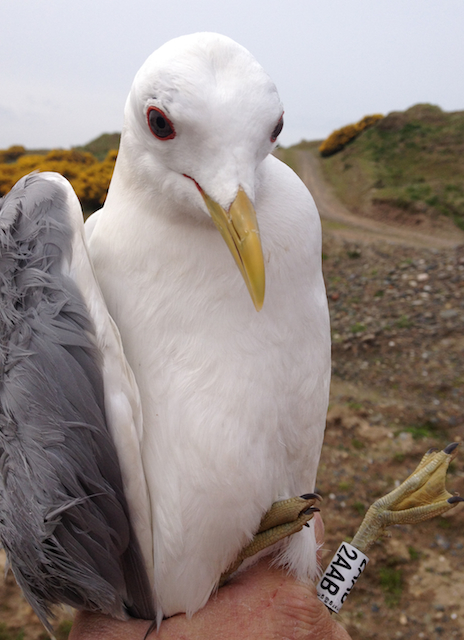
Common Gull colour ringed


The Cormorant Colour ringed project was a challenge this year the site at Maughold had changed and most of the nests were deemed inaccessible, the new site at the Point of Ayre is getting bigger with 24 nests this year 28 chicks were colour ringed here and 9 at Maughold.
Kev, Kane and Gillian


Nyger feeders were placed at 3 sites around the island to try and improve our Siskin numbers. And they worked with 290 New Siskins being ringed.


Siskin


The Rock Pipit colour ringing project carries on and some good data is being collected about site fidelity and longevity of these hardy little Pipits.
60 new birds colour ringed in 2013

Rock Pipit

Manx Buzzards
This year saw Buzzard added to the Manx ringing group list with 3 Chicks ringed.


Kay, Gary and Chris getting to grips with some Buzzard chicks

The Chough colour ring project saw another 30 Pulli colour ringed and quite a few re sightings from previous years


adult Chough ringed on Calf of Man

Loads of great Memories from 2013, some of the best would be ringing Tern chicks and Black Guillemots with my old mate Andy who came to stay again. Kane and Gillian spent a weekend ringing Terns, Cormorants, Gulls, Kestrels, Hen Harrier and Spotted Flycatcher. And 5 days i spent on the Calf of Man bird Obs with my mate Kev ringing Storm Petrel, Manx Shearwater and numerous Pipits and Willow Warbler.


Kev with Fulmar

A big thank you to everyone who gave us permission to ring on their land and helped us in anyway,
here's to a great 2014.


Well another year ends and i think that will be it for 2013 the wind gets up again tomorrow. 
2013 was again another good year for Manx ringing group

 4034 birds were caught with a total of 75 Species
3545 new birds were ringed,
487 of these were Pulli {chicks}
489 were recaptures

 Not as many as 2012 but i think that was down to trying some new stuff and concentrating on some target species where more time was put in for less numbers.

One of the highlights of the year was the success of our Tern Colonies, in the last 3 year since i have been living here the Terns both Little and Arctic have suffered from bad weather, disturbance and predation. This year the weather was great there was plenty of sand eels and the Warden spent loads of her own time to control dog walkers and tourists from to much disturbance. The result a record year with 44 breeding pairs of Little Tern.

Little Tern
12 New adults were ringed and 16 chicks, there were 4 controls

1 was born in Foulney Island, Burrow-in-Furness and is 3 years old and was caught breeding at our colony last year as well.

2 were from the colony at kilcoole, Wicklow, Ireland. and again are 3 years old.

The last control was from Brora in the Highlands of Scotland, and was ringed as a chick there 13 years ago.


16 new adult Arctic Terns and 18 chicks were ringed with 2 controls these were both ringed by Aron Sapsford as chicks at the Point of Ayre one in 1999 making it 14 years old and one in 2001 making it 12 years old.


Arctic Tern

A new site at Regaby was found to be holding a small Tree Sparrow Population and so far 27 birds have been ringed and boxes put up. The land owners have done a great job in feeding and managing the land for these great little birds

Tree Sparrow


The Whoosh site at the Point of Ayre has proved it worth again with over 700 Linnets ringed
169 Meadow pipits and 27 Twite


Linnet


A concerted effort was put in to catching Wheatear on their spring migration this year all birds bar one were caught in spring traps with 118 being ringed.


Wheatears

The colour ringing project on large Gulls goes on but chick numbers were down on last year due to what we think was predation by Polecats and Long Tails {Manx for Rat}  out of 28 Lbb Gull nest only 3 chicks were seen and ringed and only 17 Herring Gull chicks ringed. 11 GBB Gull chicks were ringed as well.

Herring Gull chicks

Kane and Gillian helping out in my Garden

The new Common Gull colour ring project got underway and we ringed
1 Adult Common Gull with 5 chicks.
The timing of the ringing was a tad late as most of the chicks had fledged, must try harder in 2014.


Common Gull colour ringed


The Cormorant Colour ringed project was a challenge this year the site at Maughold had changed and most of the nests were deemed inaccessible, the new site at the Point of Ayre is getting bigger with 24 nests this year 28 chicks were colour ringed here and 9 at Maughold.
Kev, Kane and Gillian


Nyger feeders were placed at 3 sites around the island to try and improve our Siskin numbers. And they worked with 290 New Siskins being ringed.


Siskin


The Rock Pipit colour ringing project carries on and some good data is being collected about site fidelity and longevity of these hardy little Pipits.
60 new birds colour ringed in 2013

Rock Pipit

Manx Buzzards
This year saw Buzzard added to the Manx ringing group list with 3 Chicks ringed.


Kay, Gary and Chris getting to grips with some Buzzard chicks

The Chough colour ring project saw another 30 Pulli colour ringed and quite a few re sightings from previous years


adult Chough ringed on Calf of Man

Loads of great Memories from 2013, some of the best would be ringing Tern chicks and Black Guillemots with my old mate Andy who came to stay again. Kane and Gillian spent a weekend ringing Terns, Cormorants, Gulls, Kestrels, Hen Harrier and Spotted Flycatcher. And 5 days i spent on the Calf of Man bird Obs with my mate Kev ringing Storm Petrel, Manx Shearwater and numerous Pipits and Willow Warbler.


Kev with Fulmar

A big thank you to everyone who gave us permission to ring on their land and helped us in anyway,
here's to a great 2014.


reade more... Résuméabuiyad

NOVEMBER 2013. Notable observations in Extremadura

Annotated list of the most interesting records in Extremadura in November 2013. Compiled and illustration Ttree Sparrow Passer montanus) by Sergio Mayordomo. Translated by Martin Kelsey

- White-fronted Goose: One at Los Canchales reservoir (BA) on 24/11 (Francisco Lopo, Francisco Montaño and Gema Montaño).
- Egyptian Goose: Six at Los Canchales reservoir (BA) (Toribio Álvarez) and one at Brovales reservoir, Jerezde los Caballeros (BA) (Antonio Núñez), on 01/11. Two present on a pool in La Serena (BA) on 09/11 (F. Montaño and G. Montaño). Two at La Isla pool, Navalvillar de Pela (BA), 19/11 (Juan Antonio Barquero). Two at Valdecañas reservoir (CC) on 23/11 (Dave Langlois and Sammy Langlois).
- Ruddy Shelduck: Two at Valdecañas reservoir (CC) on 08/11 (Sergio Mayordomo) and on 23/11 (D. Langlois and S. Langlois). Two at Borbollón reservoir (CC) on 16/11 (Goyo Naharro). One at Santa Amalia rice fields (BA) on 29/11 (Fernando Yuste).
- Common Shelduck: Two at Valdecañas reservoir (CC) on 08/11 (S. Mayordomo) and one on 10/11 (Javier Briz and Vicente Risco). Seven present at Sierra Brava reservoir, Zorita (CC), on 13/11 (Martin Kelsey) and two on 24/11 (José Guerra, Marc Gálvez, Miquel Ángel López and Núria Tarrasón). Two on the Santa Amalia rice fields (BA) on 22/11 (Ángel Sánchez), three on 23/11 (Á. Sánchez and F. Yuste) and six on 28/11 (Kelly Renwick, Neil Renwick and William Haworth) and on 29/11 (F. Yuste).
- Red-crested Pochard: Five on Sierra Brava reservoir, Zorita (CC), on 02/11 (A. Núñez, Eva Palacios, F. Montaño, José Gómez Aparicio, Miguel Ángel Muñoz and Vanessa de Alba) and a male there on 13/11 (Martin Kelsey). A male at Alange reservoir (BA) on 10/11 (José Guerra and Marc Gálvez). A male at Moral reservoir, Los Santos de Maimona (BA), on 17/11 (A. Núñez, César Clemente, E. Palacios, F. Montaño, M. Á. Muñoz, Paco Ramírez, S. Mayordomo and V. de Alba).

- Ferruginous Duck: Four at pool of Los Calles, Toril (CC), on 01/11 (E. Palacios -photo- and J. G. Aparicio) and on 08/11 (S. Mayordomo), and five there on 23/11 (Antolín Redondo, Guillermo Rivas and Leandro Rivas). Three at La Atalaya, Aldea del Cano (CC), on 10/11 (A. Núñez and V. de Alba) and on 17/11 (Jesús Solana), still present on 25/11 (Alejandro Puerto) and four there on 28/11 (S. Mayordomo). One at Corral Alto pool, Zorita (CC), on 30/11 (Pepe Guisado and Pilar Goñi).
- Northern Bobwhite: Two in stubble at Montijo (BA) on 15/11 (P. Herrador).
- Common Pheasant: A female in maize stubble at Vegas Altas (BA) on 24/11 (M. Á. Muñoz). One calling at Matachel River, Valencia de las Torres (BA), on 30/11 (M. Gálvez).

- Black-necked Grebe:  Two at Sierra Brava reservoir, Zorita (CC), on 10/11 (Antonio Calvo -photo-), on 13/11 and on 22/11 (M. Kelsey), and one there on 24/11 (J. Guerra, M. Gálvez, M. Á. López and N. Tarrasón). One at Moheda Alta, Navalvillar de Pela (BA), on 30/11 (M. Kelsey and S. Mayordomo).
- Squacco Heron: Two in rice fields at El Batán (CC) on 03/11 (S. Mayordomo) and one on 19/11 (C. Clemente). One seen from Puente Viejo in Badajozon 04/11 and 2 el 17/11 (Juan Carlos Paniagua). One in rice fields at Palazuelo (BA) on 24/11 (M. Á. Muñoz).
- Western Reef Egret: Possible example but a hybrid with Little Egret cannot be ruled-out, at Molino de la Aceña, Don Álvaro (BA), on 19/11 (J. Guerra).
- Black Stork: Four on the Canal de las Dehesas (BA/CC) on 01/11 (José Ángel Sánchez and Luis Salguero), one on 16/11 (A. Calvo), three on 19/11 (J. A. Barquero) and 11 on 22/11 (Á. Sánchez). One at Villar de Plasencia (CC) on 05/11 (Ricardo Montero). Two at Fresnedillas, Oliva de Plasencia (CC) on 11/11 (R. Montero) and four there on 16/11 (Javier Prieta) and also on 24/11 (Jesús Montero). Three at the El Sevillano dam, Puebla de Alcocer (BA), on 12/11 (J. A. Barquero). One at Moheda Alta, Navalvillar de Pela (BA), on 16/11 (A. Calvo).  One at Jarripa reservoir, Torremocha (CC), on 25/11 (A. Puerto). One at Galisteo (CC) on 27/11 (S. Mayordomo). Two at Dehesa de Solana, Herrera de Alcántara (CC) on 28/11 (Antonio Galán).
- Glossy Ibis: One at Galisteo (CC) on 01/11 (E. Palacios and J. G. Aparicio) and three there on 03/11 (J. Prieta and S. Mayordomo). Four at El Batán rice fields (CC) on 01/11 (E. Palacios and J. G. Aparicio) and on 05/11 (R. Montero). Four in a Cattle Egret roost at Valdeobispo lagoon (CC) on 03/11 (J. Prieta and S. Mayordomo). Five at Santa Amalia (BA) on 15/11 (José Antonio Román), on 24/11 (F. Montaño) and on 28/11 (K. Renwick, N. Renwick and W. Haworth).
- Spoonbill: Nine at Los Canchales reservoir (BA) on 11/11 (Emilio Costillo), eight on 19/11 (F. Lopo) and six on 24/11 (F. Lopo, F. Montaño and G. Montaño). Two at Brovales reservoir, Jerez de los Caballeros (BA), on 28/11 (S. Mayordomo).
- Greater Flamingo: A juvenile in the Santa Amalia rice fields (BA) on 29/11 (Fernando Yuste).
- Egyptian Vulture: Five over the Viñuelas gravel pits, Galisteo (CC), on 13/11 (S. Mayordomo).
- Goshawk: One at Vegas Altas (BA) on 01/11 (Juan Pablo Prieto and W. Haworth). One at riverside trail Plasencia (CC) on 17/11 (R. Montero).
- Osprey: One at Los Canchales reservoir (BA) on 01/11 (Toribio Álvarez), on 15/11 (Inmaculada Jerez and José Luis Bautista) and on 24/11 (F. Lopo, F. Montaño and G. Montaño). One at Portaje reservoir (CC) on 01/11 (E. Palacios and J. G. Aparicio). One at Cubilar reservoir, Logrosán (CC), on 01/11 (J. Á. Sánchez and L. Salguero) and on 30/11 (M. Kelsey). One at Borbollón reservoir (CC) on 13/11 (Kenet Sánchez and R. Montero). One at Gabriel y Galán reservoir (CC) on 18/11 (J. Montero).
- Red-footed Falcon: A male at Palazuelo (BA) on 17/11 (José Luis Pérez Chiscano).
- Common Crane: The census in the Central Zone (BA/CC) produced a figure of 43,051 birds on 15/11 (Emilio Peña, F. Yuste, Francisco Borja Maldonado, J. A. Román, J. Guerra, J. P. Prieto, Manuel Gómez Calzado, M. Gálvez and W. Haworth).
- Avocet: Five on rice fields between Palazuelo (BA) and Campo Lugar (CC) on 22/11 (M. Kelsey). 14 at Sierra Brava reservoir, Zorita (CC), on 22/11 (M. Kelsey) and three on 24/11 (J. Guerra, M. Gálvez, M. Á. López and N. Tarrasón). Two at La Albuera large lagoon (BA) on 23/11 (Godfried Schreur and Pedro Schreur).
- Kentish Plover: 47 at Valdecañas reservoir (CC) on 08/11 (S. Mayordomo). Three at Santa Amalia rice fields (BA) on 09/11 (F. Montaño and G. Montaño) and five on 24/11 (F. Montaño). 11 on rice fields between Palazuelo (BA) and Campo Lugar (CC) on 11/11 (M. Kelsey).

- Dotterel: Four on Hinojal plains (CC) on 09/11 (Chris Mills and R. Montero -photo-) and seven present there for the remainder of the month (Á. Sánchez, Antonio Ceballos, A. Núñez, Carmen Diu, C. Clemente, Chema Diu, D. Langlois, E. Palacios, Francis Martín, F. Montaño, José Luis Copete, J. Guerra, Julio Ceballos, M. Gálvez, M. Kelsey, Michel Viskens, M. Á. Muñoz, P. Ramírez, R. Montero, S. Langlois, SEO-Cáceres, S. Mayordomo and V de Alba).
- Grey Plover: Two juveniles at Valdecañas reservoir (CC) on 08/11 (C. Mills and R. Montero).
- Sanderling: One at large lagoon at La Albuera(BA) on 23/11 (G. Schreur and P. Schreur).
- Curlew Sandpiper: One at Moral reservoir, Los Santos de Maimona (BA), on 08/11 (A. Núñez and V. de Alba). Two on rice fields at Santa Amalia (BA) on 09/11 (F. Montaño and G. Montaño). One on rice fields between Palazuelo (BA) and Campo Lugar (CC) on 17/11 (M. Kelsey).
- Jack Snipe: One in irrigation canal at Galisteo (CC) on 11/11 (J. Guerra y M. Gálvez). One in rice fields at Riolobos (CC) on 13/11 (S. Mayordomo). Four in rice fields at Palazuelo (BA) on 24/11 (M. Á. Muñoz).
- Woodcock: One at Puebla de Obando (BA) on 15/11 (J. L. Bautista and P. Herrador)
- Spotted Redshank: One at Charco Salado, Casatejada (CC), on 08/11 amd another at Lugar Nuevo, Peraleda de la Mata (CC) (S. Mayordomo). Two at Santa Amalia (BA) on 09/11 (F. Montaño and G. Montaño). One on rice fields between Palazuelo (BA) and Campo Lugar (CC) on 13/11, 2 on 22/11 (M. Kelsey) and one on 28/11 (K. Renwick, N. Renwick and W. Haworth). One at La Jarillareservoir (CC) on 16/11 (J. Prieta).
- Yellow-legged Gull: At least four at Mérida landfill (BA) on 07/11 (M. Gálvez). One at Valdecañas reservoir (CC) on 08/11 (S. Mayordomo). One at Alange reservoir (BA) on 10/11 (J. Guerra and M. Gálvez). Two at Badajozlandfill on16/11 (J. C. Paniagua).
- Stock Dove: 20 at Galisteo (CC) on 05/11 (R. Montero) and two on 11/11 (J. Guerra, M. Gálvez and S. Mayordomo). 60 at Vegas Altas (BA) on 15/11 (M. Kelsey). Two at Riolobos (CC) on 20/11 (S. Mayordomo). Six at Cortijo de la Concepción, Retamal de Llerena (BA), on 30/11 (M. Gálvez).
- Ring-necked Parakeet: One seen on riverside trail, Plasencia (CC) on 03/11 (R. Montero) and on 21/11 (Montaña Domínguez).
- Monk Parakeet: Four at Parque del Príncipe de Cáceres on 04/11 (Alberto Gil) and at the municipal hostel on  17/11 (Francisco Javier Caballero).
- Long-eared Owl: Two within Badajoz city on 07/11 (J. Guerra).
- Wryneck: One at Monfragüe (CC) on 14/11 (Manolo García del Rey and Mark Hörstermann). One at Matachel River, Alange (BA) on 22/11 (J. Guerra and Lorenzo Alcántara).

- Pied Wagtail: Subspecies M. a. yarrellii: One at Mérida landfill (BA) on 07/11 (M. Gálvez). One at Soto gravel pits, Valverde de Mérida (BA) on 08/11 (J. Guerra). Two at rice fields El Batán (CC) on 13/11 and one on 20/11 and 27/11 (S. Mayordomo). One at rice fields at Riolobos (CC) on 17/11 (J. Prieta -photo-).

- Ring Ouzel: Two at Sierra del Castellar, Zafra (BA), on 11/11 (A. Núñez) and between two and four seen there from 12/11 until 25/11 (Antonia Cangas, A. Núñez, C. Clemente, Elvira del Viejo, E. Palacios, Fergus Crystal, F. Montaño -photo-, Joaquín Vázquez, José Antonio Delgado, M. Á. Muñoz, P. Ramírez, S. Mayordomo and V. de Alba).
- Goldcrest: Two in pinewood in Zafra (BA) on 21/11 (F. Montaño).
- Citril Finch: Several in pine at Serradilla (CC) on 27/11 (David Cobos).

FIRST WINTER OBSERVATIONS
- Alpine Accentor: Two at Sierra de Utrera, Oliva de Mérida (BA), on 09/11 (M. Gálvez). Two at Sierra del Castellar, Zafra (BA), on 12/11 (A. Núñez and F. Montaño) and on 17/11 (A. Núñez, C. Clemente, E. Palacios, F. Montaño, M. Á. Muñoz, P. Ramírez, S. Mayordomo and V. de Alba) and six on 25/11 (F. Montaño).

- Siskin: A female along riverside trail, Plasencia (CC) on 03/11 (J. Prieta) and a pair there on 06/11 (S. Mayordomo).
- Reed Bunting: Three at Viñuelas gravel pit, Galisteo (CC), on 03/11 (S. Mayordomo). One between Montehermoso and El Batán (CC) on 05/11 (C. Clemente). At least three at Arrocampo (CC) on 08/11 (S. Mayordomo).

LATE RECORDS OF SUMMER MIGRANTS
- Purple Heron: One at El Batán rice fields (CC) on 05/11 (C. Clemente). One at rice fields at Campo Lugar (CC) on 16/11 (A. Calvo).
- Black Kite: One at Matachel River, Valencia de las Torres (BA), on 01/11 (Manuel, Marisol Díaz and M. Gálvez).
- Booted Eagle: A pale morph at Lobón (BA) on 24/11 (Pablo Herrador).
- Lesser Kestrel: Four males between Valdivia and Entrerríos (BA) on 08/11 (J. P. Prieto). One at Campo Lugar (CC) on 09/11 (A. Calvo).
- Pallid Swift: Three at Alange (BA) on 06/11 (M. Gálvez) and on 10/11 (J. Guerra and M. Gálvez), four on 12/11 (J. Guerra and M. Gálvez) and on 19/11 (J. Solana), and one on 29/11 (J. Solana).
- Alpine Swift: 35 at Badajozon 05/11 (J. C. Paniagua). Eight at Alange (BA) on 17/11 (M. Gálvez) and three on 20/11 (Aleix Millet, Alicia Carreño, J. Guerra and M. Gálvez).
- Barn Swallow: One at Barquilla de Pinares (CC) on 02/11 (Virgilio Beltrán). One at Alange (BA) on 04/11 and on 12/11 (J. Guerra and M. Gálvez). One at Valdefuentes gravel pits, Galisteo (CC), on 11/11 (J. Guerra, M. Gálvez and S. Mayordomo). One at Villar de Rena (BA) on 15/11 (J. P. Prieto and W. Haworth). One at Sierra Brava reservoir, Zorita (CC), on 24/11 (J. Guerra, M. Gálvez, M. Á. López and N. Tarrasón).
- Red-rumped Swallow: Ten at Navalmoral de la Mata (CC) on 08/11 (J. Briz). 11 at  Valdefuentes gravel pits, Galisteo (CC) on 11/11 (J. Guerra, M. Gálvez and S. Mayordomo). One at Alange (BA) on 12/11 (J. Guerra and M. Gálvez).
- House Martin: Present at Alange (BA) throughout the whole of November, e.g. three on 12/11 and five on 16/11 (J. Guerra and M. Gálvez). One at Olivenza (BA) on 17/11 (Arturo Domínguez).
- Northern Wheatear: One between Villanueva de la Serena and Magacela (BA) on 04/11. One at Casas de Belvís (CC) on 10/11 (J. Briz).
- Iberian Chiffchaff: One at Galisteo (CC) on 03/11 (J. Prieta and S. Mayordomo). One at Alange (BA) on 06/11 and another on 13/11 (M. Gálvez).

- Willow Warbler: One at Los Santos de Maimona (BA) on 08/11 (A. Núñez and V. de Alba).
Annotated list of the most interesting records in Extremadura in November 2013. Compiled and illustration Ttree Sparrow Passer montanus) by Sergio Mayordomo. Translated by Martin Kelsey

- White-fronted Goose: One at Los Canchales reservoir (BA) on 24/11 (Francisco Lopo, Francisco Montaño and Gema Montaño).
- Egyptian Goose: Six at Los Canchales reservoir (BA) (Toribio Álvarez) and one at Brovales reservoir, Jerezde los Caballeros (BA) (Antonio Núñez), on 01/11. Two present on a pool in La Serena (BA) on 09/11 (F. Montaño and G. Montaño). Two at La Isla pool, Navalvillar de Pela (BA), 19/11 (Juan Antonio Barquero). Two at Valdecañas reservoir (CC) on 23/11 (Dave Langlois and Sammy Langlois).
- Ruddy Shelduck: Two at Valdecañas reservoir (CC) on 08/11 (Sergio Mayordomo) and on 23/11 (D. Langlois and S. Langlois). Two at Borbollón reservoir (CC) on 16/11 (Goyo Naharro). One at Santa Amalia rice fields (BA) on 29/11 (Fernando Yuste).
- Common Shelduck: Two at Valdecañas reservoir (CC) on 08/11 (S. Mayordomo) and one on 10/11 (Javier Briz and Vicente Risco). Seven present at Sierra Brava reservoir, Zorita (CC), on 13/11 (Martin Kelsey) and two on 24/11 (José Guerra, Marc Gálvez, Miquel Ángel López and Núria Tarrasón). Two on the Santa Amalia rice fields (BA) on 22/11 (Ángel Sánchez), three on 23/11 (Á. Sánchez and F. Yuste) and six on 28/11 (Kelly Renwick, Neil Renwick and William Haworth) and on 29/11 (F. Yuste).
- Red-crested Pochard: Five on Sierra Brava reservoir, Zorita (CC), on 02/11 (A. Núñez, Eva Palacios, F. Montaño, José Gómez Aparicio, Miguel Ángel Muñoz and Vanessa de Alba) and a male there on 13/11 (Martin Kelsey). A male at Alange reservoir (BA) on 10/11 (José Guerra and Marc Gálvez). A male at Moral reservoir, Los Santos de Maimona (BA), on 17/11 (A. Núñez, César Clemente, E. Palacios, F. Montaño, M. Á. Muñoz, Paco Ramírez, S. Mayordomo and V. de Alba).

- Ferruginous Duck: Four at pool of Los Calles, Toril (CC), on 01/11 (E. Palacios -photo- and J. G. Aparicio) and on 08/11 (S. Mayordomo), and five there on 23/11 (Antolín Redondo, Guillermo Rivas and Leandro Rivas). Three at La Atalaya, Aldea del Cano (CC), on 10/11 (A. Núñez and V. de Alba) and on 17/11 (Jesús Solana), still present on 25/11 (Alejandro Puerto) and four there on 28/11 (S. Mayordomo). One at Corral Alto pool, Zorita (CC), on 30/11 (Pepe Guisado and Pilar Goñi).
- Northern Bobwhite: Two in stubble at Montijo (BA) on 15/11 (P. Herrador).
- Common Pheasant: A female in maize stubble at Vegas Altas (BA) on 24/11 (M. Á. Muñoz). One calling at Matachel River, Valencia de las Torres (BA), on 30/11 (M. Gálvez).

- Black-necked Grebe:  Two at Sierra Brava reservoir, Zorita (CC), on 10/11 (Antonio Calvo -photo-), on 13/11 and on 22/11 (M. Kelsey), and one there on 24/11 (J. Guerra, M. Gálvez, M. Á. López and N. Tarrasón). One at Moheda Alta, Navalvillar de Pela (BA), on 30/11 (M. Kelsey and S. Mayordomo).
- Squacco Heron: Two in rice fields at El Batán (CC) on 03/11 (S. Mayordomo) and one on 19/11 (C. Clemente). One seen from Puente Viejo in Badajozon 04/11 and 2 el 17/11 (Juan Carlos Paniagua). One in rice fields at Palazuelo (BA) on 24/11 (M. Á. Muñoz).
- Western Reef Egret: Possible example but a hybrid with Little Egret cannot be ruled-out, at Molino de la Aceña, Don Álvaro (BA), on 19/11 (J. Guerra).
- Black Stork: Four on the Canal de las Dehesas (BA/CC) on 01/11 (José Ángel Sánchez and Luis Salguero), one on 16/11 (A. Calvo), three on 19/11 (J. A. Barquero) and 11 on 22/11 (Á. Sánchez). One at Villar de Plasencia (CC) on 05/11 (Ricardo Montero). Two at Fresnedillas, Oliva de Plasencia (CC) on 11/11 (R. Montero) and four there on 16/11 (Javier Prieta) and also on 24/11 (Jesús Montero). Three at the El Sevillano dam, Puebla de Alcocer (BA), on 12/11 (J. A. Barquero). One at Moheda Alta, Navalvillar de Pela (BA), on 16/11 (A. Calvo).  One at Jarripa reservoir, Torremocha (CC), on 25/11 (A. Puerto). One at Galisteo (CC) on 27/11 (S. Mayordomo). Two at Dehesa de Solana, Herrera de Alcántara (CC) on 28/11 (Antonio Galán).
- Glossy Ibis: One at Galisteo (CC) on 01/11 (E. Palacios and J. G. Aparicio) and three there on 03/11 (J. Prieta and S. Mayordomo). Four at El Batán rice fields (CC) on 01/11 (E. Palacios and J. G. Aparicio) and on 05/11 (R. Montero). Four in a Cattle Egret roost at Valdeobispo lagoon (CC) on 03/11 (J. Prieta and S. Mayordomo). Five at Santa Amalia (BA) on 15/11 (José Antonio Román), on 24/11 (F. Montaño) and on 28/11 (K. Renwick, N. Renwick and W. Haworth).
- Spoonbill: Nine at Los Canchales reservoir (BA) on 11/11 (Emilio Costillo), eight on 19/11 (F. Lopo) and six on 24/11 (F. Lopo, F. Montaño and G. Montaño). Two at Brovales reservoir, Jerez de los Caballeros (BA), on 28/11 (S. Mayordomo).
- Greater Flamingo: A juvenile in the Santa Amalia rice fields (BA) on 29/11 (Fernando Yuste).
- Egyptian Vulture: Five over the Viñuelas gravel pits, Galisteo (CC), on 13/11 (S. Mayordomo).
- Goshawk: One at Vegas Altas (BA) on 01/11 (Juan Pablo Prieto and W. Haworth). One at riverside trail Plasencia (CC) on 17/11 (R. Montero).
- Osprey: One at Los Canchales reservoir (BA) on 01/11 (Toribio Álvarez), on 15/11 (Inmaculada Jerez and José Luis Bautista) and on 24/11 (F. Lopo, F. Montaño and G. Montaño). One at Portaje reservoir (CC) on 01/11 (E. Palacios and J. G. Aparicio). One at Cubilar reservoir, Logrosán (CC), on 01/11 (J. Á. Sánchez and L. Salguero) and on 30/11 (M. Kelsey). One at Borbollón reservoir (CC) on 13/11 (Kenet Sánchez and R. Montero). One at Gabriel y Galán reservoir (CC) on 18/11 (J. Montero).
- Red-footed Falcon: A male at Palazuelo (BA) on 17/11 (José Luis Pérez Chiscano).
- Common Crane: The census in the Central Zone (BA/CC) produced a figure of 43,051 birds on 15/11 (Emilio Peña, F. Yuste, Francisco Borja Maldonado, J. A. Román, J. Guerra, J. P. Prieto, Manuel Gómez Calzado, M. Gálvez and W. Haworth).
- Avocet: Five on rice fields between Palazuelo (BA) and Campo Lugar (CC) on 22/11 (M. Kelsey). 14 at Sierra Brava reservoir, Zorita (CC), on 22/11 (M. Kelsey) and three on 24/11 (J. Guerra, M. Gálvez, M. Á. López and N. Tarrasón). Two at La Albuera large lagoon (BA) on 23/11 (Godfried Schreur and Pedro Schreur).
- Kentish Plover: 47 at Valdecañas reservoir (CC) on 08/11 (S. Mayordomo). Three at Santa Amalia rice fields (BA) on 09/11 (F. Montaño and G. Montaño) and five on 24/11 (F. Montaño). 11 on rice fields between Palazuelo (BA) and Campo Lugar (CC) on 11/11 (M. Kelsey).

- Dotterel: Four on Hinojal plains (CC) on 09/11 (Chris Mills and R. Montero -photo-) and seven present there for the remainder of the month (Á. Sánchez, Antonio Ceballos, A. Núñez, Carmen Diu, C. Clemente, Chema Diu, D. Langlois, E. Palacios, Francis Martín, F. Montaño, José Luis Copete, J. Guerra, Julio Ceballos, M. Gálvez, M. Kelsey, Michel Viskens, M. Á. Muñoz, P. Ramírez, R. Montero, S. Langlois, SEO-Cáceres, S. Mayordomo and V de Alba).
- Grey Plover: Two juveniles at Valdecañas reservoir (CC) on 08/11 (C. Mills and R. Montero).
- Sanderling: One at large lagoon at La Albuera(BA) on 23/11 (G. Schreur and P. Schreur).
- Curlew Sandpiper: One at Moral reservoir, Los Santos de Maimona (BA), on 08/11 (A. Núñez and V. de Alba). Two on rice fields at Santa Amalia (BA) on 09/11 (F. Montaño and G. Montaño). One on rice fields between Palazuelo (BA) and Campo Lugar (CC) on 17/11 (M. Kelsey).
- Jack Snipe: One in irrigation canal at Galisteo (CC) on 11/11 (J. Guerra y M. Gálvez). One in rice fields at Riolobos (CC) on 13/11 (S. Mayordomo). Four in rice fields at Palazuelo (BA) on 24/11 (M. Á. Muñoz).
- Woodcock: One at Puebla de Obando (BA) on 15/11 (J. L. Bautista and P. Herrador)
- Spotted Redshank: One at Charco Salado, Casatejada (CC), on 08/11 amd another at Lugar Nuevo, Peraleda de la Mata (CC) (S. Mayordomo). Two at Santa Amalia (BA) on 09/11 (F. Montaño and G. Montaño). One on rice fields between Palazuelo (BA) and Campo Lugar (CC) on 13/11, 2 on 22/11 (M. Kelsey) and one on 28/11 (K. Renwick, N. Renwick and W. Haworth). One at La Jarillareservoir (CC) on 16/11 (J. Prieta).
- Yellow-legged Gull: At least four at Mérida landfill (BA) on 07/11 (M. Gálvez). One at Valdecañas reservoir (CC) on 08/11 (S. Mayordomo). One at Alange reservoir (BA) on 10/11 (J. Guerra and M. Gálvez). Two at Badajozlandfill on16/11 (J. C. Paniagua).
- Stock Dove: 20 at Galisteo (CC) on 05/11 (R. Montero) and two on 11/11 (J. Guerra, M. Gálvez and S. Mayordomo). 60 at Vegas Altas (BA) on 15/11 (M. Kelsey). Two at Riolobos (CC) on 20/11 (S. Mayordomo). Six at Cortijo de la Concepción, Retamal de Llerena (BA), on 30/11 (M. Gálvez).
- Ring-necked Parakeet: One seen on riverside trail, Plasencia (CC) on 03/11 (R. Montero) and on 21/11 (Montaña Domínguez).
- Monk Parakeet: Four at Parque del Príncipe de Cáceres on 04/11 (Alberto Gil) and at the municipal hostel on  17/11 (Francisco Javier Caballero).
- Long-eared Owl: Two within Badajoz city on 07/11 (J. Guerra).
- Wryneck: One at Monfragüe (CC) on 14/11 (Manolo García del Rey and Mark Hörstermann). One at Matachel River, Alange (BA) on 22/11 (J. Guerra and Lorenzo Alcántara).

- Pied Wagtail: Subspecies M. a. yarrellii: One at Mérida landfill (BA) on 07/11 (M. Gálvez). One at Soto gravel pits, Valverde de Mérida (BA) on 08/11 (J. Guerra). Two at rice fields El Batán (CC) on 13/11 and one on 20/11 and 27/11 (S. Mayordomo). One at rice fields at Riolobos (CC) on 17/11 (J. Prieta -photo-).

- Ring Ouzel: Two at Sierra del Castellar, Zafra (BA), on 11/11 (A. Núñez) and between two and four seen there from 12/11 until 25/11 (Antonia Cangas, A. Núñez, C. Clemente, Elvira del Viejo, E. Palacios, Fergus Crystal, F. Montaño -photo-, Joaquín Vázquez, José Antonio Delgado, M. Á. Muñoz, P. Ramírez, S. Mayordomo and V. de Alba).
- Goldcrest: Two in pinewood in Zafra (BA) on 21/11 (F. Montaño).
- Citril Finch: Several in pine at Serradilla (CC) on 27/11 (David Cobos).

FIRST WINTER OBSERVATIONS
- Alpine Accentor: Two at Sierra de Utrera, Oliva de Mérida (BA), on 09/11 (M. Gálvez). Two at Sierra del Castellar, Zafra (BA), on 12/11 (A. Núñez and F. Montaño) and on 17/11 (A. Núñez, C. Clemente, E. Palacios, F. Montaño, M. Á. Muñoz, P. Ramírez, S. Mayordomo and V. de Alba) and six on 25/11 (F. Montaño).

- Siskin: A female along riverside trail, Plasencia (CC) on 03/11 (J. Prieta) and a pair there on 06/11 (S. Mayordomo).
- Reed Bunting: Three at Viñuelas gravel pit, Galisteo (CC), on 03/11 (S. Mayordomo). One between Montehermoso and El Batán (CC) on 05/11 (C. Clemente). At least three at Arrocampo (CC) on 08/11 (S. Mayordomo).

LATE RECORDS OF SUMMER MIGRANTS
- Purple Heron: One at El Batán rice fields (CC) on 05/11 (C. Clemente). One at rice fields at Campo Lugar (CC) on 16/11 (A. Calvo).
- Black Kite: One at Matachel River, Valencia de las Torres (BA), on 01/11 (Manuel, Marisol Díaz and M. Gálvez).
- Booted Eagle: A pale morph at Lobón (BA) on 24/11 (Pablo Herrador).
- Lesser Kestrel: Four males between Valdivia and Entrerríos (BA) on 08/11 (J. P. Prieto). One at Campo Lugar (CC) on 09/11 (A. Calvo).
- Pallid Swift: Three at Alange (BA) on 06/11 (M. Gálvez) and on 10/11 (J. Guerra and M. Gálvez), four on 12/11 (J. Guerra and M. Gálvez) and on 19/11 (J. Solana), and one on 29/11 (J. Solana).
- Alpine Swift: 35 at Badajozon 05/11 (J. C. Paniagua). Eight at Alange (BA) on 17/11 (M. Gálvez) and three on 20/11 (Aleix Millet, Alicia Carreño, J. Guerra and M. Gálvez).
- Barn Swallow: One at Barquilla de Pinares (CC) on 02/11 (Virgilio Beltrán). One at Alange (BA) on 04/11 and on 12/11 (J. Guerra and M. Gálvez). One at Valdefuentes gravel pits, Galisteo (CC), on 11/11 (J. Guerra, M. Gálvez and S. Mayordomo). One at Villar de Rena (BA) on 15/11 (J. P. Prieto and W. Haworth). One at Sierra Brava reservoir, Zorita (CC), on 24/11 (J. Guerra, M. Gálvez, M. Á. López and N. Tarrasón).
- Red-rumped Swallow: Ten at Navalmoral de la Mata (CC) on 08/11 (J. Briz). 11 at  Valdefuentes gravel pits, Galisteo (CC) on 11/11 (J. Guerra, M. Gálvez and S. Mayordomo). One at Alange (BA) on 12/11 (J. Guerra and M. Gálvez).
- House Martin: Present at Alange (BA) throughout the whole of November, e.g. three on 12/11 and five on 16/11 (J. Guerra and M. Gálvez). One at Olivenza (BA) on 17/11 (Arturo Domínguez).
- Northern Wheatear: One between Villanueva de la Serena and Magacela (BA) on 04/11. One at Casas de Belvís (CC) on 10/11 (J. Briz).
- Iberian Chiffchaff: One at Galisteo (CC) on 03/11 (J. Prieta and S. Mayordomo). One at Alange (BA) on 06/11 and another on 13/11 (M. Gálvez).

- Willow Warbler: One at Los Santos de Maimona (BA) on 08/11 (A. Núñez and V. de Alba).
reade more... Résuméabuiyad

FATS in the Watagans

Murray Lord kindly offered to drive me up to the Watagan Mountains this past Saturday to attend the FATS (Frog and Tadpole Society) field outing. Unlike most of my attempts at frogging and herping this year, it was quite a successful night (even if the professionals thought the numbers were very low!). Here are a few of my shots.

Southern Dwarf Crowned Snake (Cacophis krefftii)

Southern Barred Frog (Mixophyes iteratus)

Southern Leaf-tailed Gecko (Saltuarius swaini)

Blue Mountains Tree Frog (Litoria citropa)
Murray Lord kindly offered to drive me up to the Watagan Mountains this past Saturday to attend the FATS (Frog and Tadpole Society) field outing. Unlike most of my attempts at frogging and herping this year, it was quite a successful night (even if the professionals thought the numbers were very low!). Here are a few of my shots.

Southern Dwarf Crowned Snake (Cacophis krefftii)

Southern Barred Frog (Mixophyes iteratus)

Southern Leaf-tailed Gecko (Saltuarius swaini)

Blue Mountains Tree Frog (Litoria citropa)
reade more... Résuméabuiyad

The Returning Forties

Day 9: 23rd November
We awoke early at our anchorage at Campbell Island to scan the shoreline of Perseverance Harbour with Dani's and Rob's scopes for Campbell Teal, but were unsuccessful save for myself and Rob briefly seeing one scuttle off the shoreline into some tussocks from a great distance.

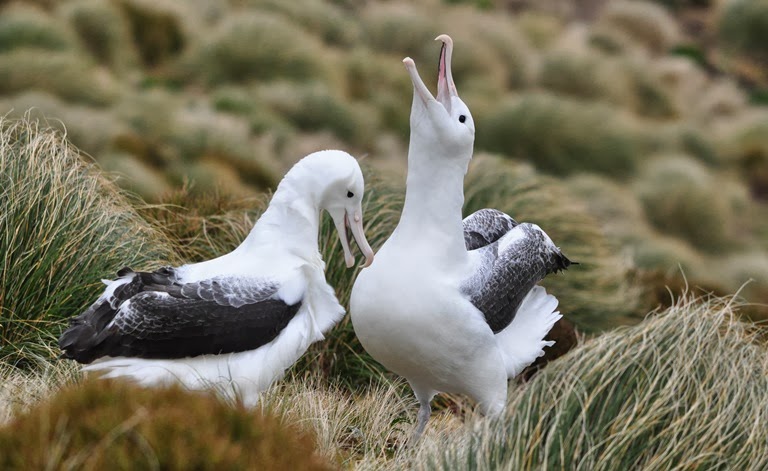
Rob, Dani, Keith and I all very happily opted for the option to make the very difficult trek up Mt Honey to see the Campbell Snipe with Adam. On being dropped off, we walked a very muddy and slippery path before cutting left and bush bashing through the dense tea trees up the hill, many of them very dense and very spiny! We finally reached the open tussock slopes and within a few minutes had great views of one bird (which I accidentally photographed on manual). We kept looking around and had one Southern Royal Albatross near a nest and 3 more Snipe (2 of them being a fat chick and mum). Numerous Campbell Pipits around the area, and a fantastic view! Nobody had a wide-angle lens with them.
Campbell Island Snipe

We opted to follow the creek line back down to avoid the tea trees, which was an excellent decision and took very little effort, though we had to watch out for the deep 2m sinkholes carved out by flowing water underground!

Soon after eventually reaching the path, a call came through the radio that the zodiacs (which we could see down in the bay) were looking at teals. Dani and I with our young legs ran down the mountain back to the bay where we had left the scope (had a couple of near slips and falls on the way), but on our arrival (4 minutes after the radio), the zodiacs were moving away, evidently the teal had gone ashore and hidden, confirmed with a scan through the scope. Rob, Keith and Adam soon arrived, and despite Rob's best pessimistic arguments, I walked around to where I thought the zodiacs had been stopped, and two fantastic Campbell Flightless Teal swam out from behind a rock and, unexpectedly, right towards me. I waved the others over (they ran very quickly!), and we all had amazing views of this pair of rare ducks. A few years ago it would have been unthinkable to get both the teal and the snipe in 3 hours, so they are obviously recovering well on their now predator-free island home!

Yep, he is indeed Flightless
Curious female Campbell Teal
Calling Male

Our zodiac ride back to the ship for lunch yielded some very nice close up views of Campbell Shag.

Campbell Shag - I had 11 shags on this trip!

The afternoon was spent hiking up to the Southern Royal Albatross nesting area above Perseverance Harbour and watching the (limited) courtship displays as he afternoon progressed. Had some very memorable views of the albatross, and after lying down in one spot for 15 minutes, heard a trill and turned my head to find a Campbell Pipit sitting 20cm from my face, and he regarded me quizzically before resuming feeding around me.

Campbell Pipit
The lonely outpost
Yawn and Stretch
The Call
Takeoff
Tenderly
Courtship
Threesome?

Had a few bully sea lions on the way back down too, which a number of the other expeditioners were too scared to walk past. It's difficult when they're sitting on the board walk.

A whole day on Campbell Island, and not a single Campbell Albatross...

ADDENDUM: Don't worry, we saw a few in the dying light at 9:30pm as we headed offshore, along with a few nice Grey-headed.


Day 10: 24th November
Woke up too late and missed Hourglass Dolphins off the front of the boat. Nothing else of particular note for the rest of the day, was so slow in fact that Dani, Rob and I all took the opportunity for a siesta. However "slow" in this definition is only seeing the same birds as the days preceding, which in all honesty are fantastic pelagic birds! The late nights and early mornings were, however, taking their toll.

Day 11: 25th November
Tried to get an early start, but I was in fact one of the last on the bridge due to a miscalculation on my part (sun rose at 5, not 6). The birding began very similar to the previous day, with the addition of numerous Antipodean Albatross, with a number of pale male, typical male and female birds observed, some causing a bit of controversy as they flew alongside Gibson's (why these two subspecies are not split I have no idea). Also had a quick (but close) flyby of two Grey Petrels which I almost missed due to a toilet break!

We arrived at the Antipodes (by definition the other side of the world) at 11:18am, but we had to stew inside as the ship moved around to Anchorage Bay to reduce the danger of loading zodiacs (in the end it was still very difficult, Sue getting drenched up to the waist by a rouge wave, however miraculously remaining dry inside apart from her left gumboot).

Finally, after a quick lunch and much confusion about the surrounding prions, we boarded the zodiacs and headed off. I didn't take the short lens because switching on a zodiac is a terrible idea, but under the blue sky and southern sun, the scenery was amazing, with cliffs towering vertically above us, spotted with the occasional Cape Petrel or LMSA.


We cruised round to a small colony of Erect-crested Penguins (a few Southern Rockhoppers on the way), and while waiting in queue to get in close with our zodiac, I spotted a parakeet fly into a tussock above us. After a tense half-hour, everybody in all five boats had fantastic views of both Antipodes (the rarer species, identified first) and Reischek's Parakeet, the former being very much a luck bird, and often seen only poorly in flight rather than our prolonged views on a ridge! Very exciting, as it is rare that everybody on the zodiacs sees both species!)

Antipodes Parakeets
Reischek's Parakeet
Erect Pair

Spent the rest of the cruise photographing New Zealand Fur Seals (including one male Sub-Antarctic), pipits, penguins, and a few more Reischek's. With the aid of photos, Rob, Dani and I did finally pick out one prion looping around the sea cliffs which was *certainly* a Fulmar Prion.

The Circle of Life
Antipodes Pipit
Male Subantarctic Sea Lion
Artistic-crested Penguin

Currently waiting for dinner in the leeward side of the island and arguing about prion identification.

The other side of the world

And a quick shout-out to the Million Dollar Mouse Project, which still needs the support of a few more donors to reach their goal of eradicating mice from the Antipodes - a truly worthy cause, and something which I hope is indeed achieved as soon as possible! 


Day 12: 26th November
Woke up at the Bounty Islands, greeted by numerous Bounty Shags circling the ship. A sobering thought to think that we were probably the first people to see this species this year, highlighting how isolated we are from civilisation. The true spirit of the Southern Ocean!

Bounty Shag
Salvin's Albatross resting on the water...
With the Bounty Islands behind

Thousands of Salvin's Albatross glided around in the wind (too strong for zodiacs), and Fulmar Prions were abundant (however of course there were still a few Faries mixed in just to confuse us).

Fulmar Prion 1*
Fulmar Prion 2*
Fairyish Fulmar Prion 3*
Fulmar Prion 4*

*Labelled prion may not necessarily be the given species, but I think they are! 

As we headed away from these exquisite islands, we chucked a bit of chum over the side and had hundreds of Salvin's Albatross fighting over chunks of Barracuda in front of us.

The Sunlit Bounty Islands - named for Captain Bligh's ship...
... not for the Bounty of Birdlife here!

Salvin's Albatross 

 To the top deck we have now moved, as we just entered Magenta Petrel and Chatham Petrel territory. Non-stop petrel vigil for the next few days is guaranteed. Signing out for the moment...

... The rest of the day was very slow, with the only identifiable cetaceans being a few Long-finned Pilot Whales, and the birds being the same as previous days in even lower densities. Had some very good views of Subantarctic Little Shearwater and Soft-plumaged Petrels in the evening whilst skipping entree (scoffed the main down in 3 minutes flat to get back out), including two Intermediate/Dark morph birds.

Speaking of which, the food cooked by Bruce and Dean was fantastic for the whole trip, and the lovely serving staff were always knowingly providing Dani and myself with seconds, often even before we asked!!! 10/10 haha!

Day 13: 27th November
4:47am start for crossing the best* stretch of water for pelagic birding in the world - the Chatham Rise. Species such as Magenta Petrel and Chatham Petrel feed in these waters alongside various species of Beaked Whales and dolphins.

Today, it was a desert.

Around 5 hours after our fruitless early wake up, we found out why we were only getting spatterings of albatross, White-faced Storm Petrels and not one single Pterodroma. In the distance we spotted what else but a fishing trawler. And what was behind it but a dense stream of birds stretching for miles behind it, as far as the binocular could see! We estimated more than 30,000 birds. It was an amazing spectacle... which we observed from a distance of 5 miles... And as soon as we turned and started heading over, the trawler turned and steamed away from us at top speed (presumably thinking we were inspectors haha).

The birds in the wake of this ship stretched for so far that we actually picked some up even from the immense distance between us, so we did a little chumming. Had good numbers of both Chatham and Pacific (Northern) Buller's Albatross. Those of us remaining on the top deck were treated to two Sperm Whales popping up 50m away and hanging around for a few minutes.

Northern Buller's Albatross
Chatham Albatross and photobombing NBA
Every man for himself!
Chatham Albatross
It's sharp, but someone's head is in the way...

Our rare petrel vigil remained fruitless as we steamed towards The Pyramid. Rising out of the water just south of the main Chatham Islands, this rock holds almost the whole worldwide Chatham Albatross population.

The... sideways... Pyramid... 
Blogger won't let me rotate these photos...

An unfavourable weather forecast saw Rodney decide to move our zodiacing around South-East Island forward 2 days - a good move! While it was very bumpy, and the light wasn't ideal, we still managed to get some excellent birds including Shore Plover, Chatham Little Penguin, Chatham Tui, Chatham Red-crowned Parakeet , Chatham Brown Skua, and many Pitt Island Shags.

Pitt Island Shags
Shore Plover - one of the rarest birds in the world
Only about 100 left in the wild
The possible future species of Chatham Skua

Frustratingly, the conditions rendered accurate ID of three observed Petroica Robins impossible, although I am always going to be convinced that indeed I have seen both Chatham Tomtit and Black Robin...

This zodiac trip left us running late for our rendezvous with the Horns for Magenta Petrel in the evening, and despite our vigil until we could no longer tell Buller's Albatross from Pterodromas (yes, I made that mis-ID), as the trip currently stands we remain Magentaless... (and Oystercatcherless)

As a consolation, we did conveniently have excellent views of a single Chatham Shag, which flew from the breeding island directly out to the ship before circling three times just above eye level and heading straight back to the island.

Day 14: 28th November
Bittersweet - birding can be harsh

After our earliest ship-official wake up of the trip at 5:45 (of course on the first day we could have actually slept in!), we headed over to Waitangi on the very wet zodiacs. On arrival, a Chatham Oystercatcher was already scoped, and as we were discussing how to get better views, it flew 1km along the coast and landed only 50m from us - it was great to get this sometimes stressful bird early in the day - there are no backups!

No backups needed - Chatham Oystercatcher

The next few hours were spent at Tuku Reserve, where (with effort) I got good views of Chatham Pigeon, Chatham Gerygone (this bird was much harder to see than expected!), the Chatham races of Fantail and Tui, and also an obliging Buff Weka, an introduced subspecies now extinct at it's source. Rob also got both species (not after a bit of stress) after returning from his Taiko Encounter.

Chatham Pigeon - once almost extinct, now common!
Great conservation work has been done by the owners of Tuku Reserve!

As the wind picked up to 40 knots and the rain began to fall heavily from the heavens, we headed to Waitangi Hotel for a "cultural exchange". After some difficulty and delay, transfer back to the ship was eventually organised and Rob and I cracked ourselves up as Rodney gunned the zodiac across the bay and soaked everyone in the boat from head to toe.

Visibility was poor as we headed south to the area directly offshore from the Taiko Trust breeding reserve. The 40 knot wind made chumming impractical, and birds shot past the boat in less than 5 seconds after appearing through the mist. It was looking grim as dinner was called until from the side of the boat came "it's got a dark hood and white... ... MAGENTA PETREL!!!"

All still on the bridge watched as it flew parallel to the ship for a time before disappearing atmospherically into the mist. Everyone who was skipping dinner had very good (albeit distant) views of the world's rarest seabird, with only 9 pairs currently breeding and a world population of approximately 40 birds - high fives exchanged all round as Dani showed off his proof photo.

Now, after seeing such a bird, most people would be over the moon, which I was until I missed that damn Chatham Petrel flying in front of the bow while I was scanning our wake a few minutes later! Bittersweet indeed, couldn't quite celebrate as much as the lucky few.

Yet, who can't be happy after Magenta Petrel?!?! That is a fantastic bird to cherish indeed!

Three full days at sea en. route to Dunedin will hopefully lift my spirits.

Day 15: 29th November
Surprise! What a way to clean up the Southern Ocean and make our way to the best Birding Down Under list OF ALL TIME! The day started well with huge waves and strong winds, my first tickable cooklaria being Black-winged Petrel closely followed by Cook's Petrel. As the day wore on we continuously checked the cooklarias coming past in the hope of rarities, alas to no avail (yet)...

We repeatedly checked the White-chinned Petrels and after pointing out one to Dani which appeared to have a different jizz, photos confirmed Westland Petrel! A rare bird on this leg of the trip.

At this point, Dani and I had  been discussing the Great Australian Great Shearwater Influx of '11 for a few minutes, and we were still talking about Great Shearwaters when I noticed a very pale Buller's Shearwater right behind the boat and HOLY CR@P IT'S A GREAT SHEARWATER!!! The second mega vagrant of the trip after Chinstrap Penguin and (somehow) Dani's 3rd trip vagrant for NZ (the first being Dunlin, the second being a different Great Shear in the Haraki Gulf... Don't ask me how he managed that).

An ill-timed shower left me Gould's Petrelless (thank god it wasn't a Steineger's as originally called), and at bird log a discussion with Adam revealed that our total trip count of 46 tubenoses was a record for BDU (my count of course now being 44 lacking Exulans Albatross and Chatham Petrel). The next two days will be spent trying to crack 50 - stay tuned!

Buller's Shearwater

Day 16: 30th November
Fairly quiet and relaxing day, but we added Flesh-footed, Fluttering and Hutton's Shearwater to the trip list bringing us to 49, with either Pycroft's Petrel or some mega vagrant like Laysan Albatross needed to bring us up to 50. Also an unexpected double Southern Fulmar today with a number of Great Albatross around the ship which I used to work on my ID skills.

Day 17: 1st December
Summer has arrived, and I can still see Cape Petrels wheeling around with Salvin's Albatross. We have now moved away from the Chatham Rise, and are due to arrive at Dunedin 14 hours early (5:00pm today) - we could already see the snow capped peaks of the South Island before breakfast. Birds are few and far between, with only a few different species, quite a contrast to yesterday. I guess we're slowly being weaned off the spectacular variety of Southern Ocean pelagic species as we all prepare to go home tomorrow. Dusky Dolphins have been seen a few times at the bow, but most people (including Rob, Dani and myself) have given up birding for a well-deserved rest as the wind remains up around 40 knots! The expedition recount in the lecture room was an excellent way to conclude the experience before a final dinner in the dining room.

Day 18: 2nd December
And so this experience of a life time comes to an end. Wow. I know I've written 11 pages of text on my experiences, but I could never fully convey how extraordinary this trip was. Congratulations to the Heritage team and Rodney for pulling off a flawless birding trip. Thank you to the guides and zodiac drivers (Adam, Meghan, Samuel and Agnes) for getting us the birds, the dining staff, the Russian crew, all those who put up with my questions and excessive enthusiasm, and to all the new birding friends I have made - may your future avian endeavors be prosperous! It will probably be a few decades, but the Southern Ocean has hooked me, so I know one day I'll be back (plus the Heritage Far East and WPO expeditions have taken my fancy also!).

Until then, one very happy Enderby Trust Scholarship recipient signing out.

Joshua Bergmark


Of course this Great Albatross is unidentifiable to species* level...
That's how birding in the Southern Ocean works!
* or subspecies - no taxonomic arguments here!
Day 9: 23rd November
We awoke early at our anchorage at Campbell Island to scan the shoreline of Perseverance Harbour with Dani's and Rob's scopes for Campbell Teal, but were unsuccessful save for myself and Rob briefly seeing one scuttle off the shoreline into some tussocks from a great distance.

Rob, Dani, Keith and I all very happily opted for the option to make the very difficult trek up Mt Honey to see the Campbell Snipe with Adam. On being dropped off, we walked a very muddy and slippery path before cutting left and bush bashing through the dense tea trees up the hill, many of them very dense and very spiny! We finally reached the open tussock slopes and within a few minutes had great views of one bird (which I accidentally photographed on manual). We kept looking around and had one Southern Royal Albatross near a nest and 3 more Snipe (2 of them being a fat chick and mum). Numerous Campbell Pipits around the area, and a fantastic view! Nobody had a wide-angle lens with them.

Campbell Island Snipe

We opted to follow the creek line back down to avoid the tea trees, which was an excellent decision and took very little effort, though we had to watch out for the deep 2m sinkholes carved out by flowing water underground!

Soon after eventually reaching the path, a call came through the radio that the zodiacs (which we could see down in the bay) were looking at teals. Dani and I with our young legs ran down the mountain back to the bay where we had left the scope (had a couple of near slips and falls on the way), but on our arrival (4 minutes after the radio), the zodiacs were moving away, evidently the teal had gone ashore and hidden, confirmed with a scan through the scope. Rob, Keith and Adam soon arrived, and despite Rob's best pessimistic arguments, I walked around to where I thought the zodiacs had been stopped, and two fantastic Campbell Flightless Teal swam out from behind a rock and, unexpectedly, right towards me. I waved the others over (they ran very quickly!), and we all had amazing views of this pair of rare ducks. A few years ago it would have been unthinkable to get both the teal and the snipe in 3 hours, so they are obviously recovering well on their now predator-free island home!

Yep, he is indeed Flightless
Curious female Campbell Teal
Calling Male

Our zodiac ride back to the ship for lunch yielded some very nice close up views of Campbell Shag.

Campbell Shag - I had 11 shags on this trip!

The afternoon was spent hiking up to the Southern Royal Albatross nesting area above Perseverance Harbour and watching the (limited) courtship displays as he afternoon progressed. Had some very memorable views of the albatross, and after lying down in one spot for 15 minutes, heard a trill and turned my head to find a Campbell Pipit sitting 20cm from my face, and he regarded me quizzically before resuming feeding around me.

Campbell Pipit
The lonely outpost
Yawn and Stretch
The Call
Takeoff
Tenderly
Courtship
Threesome?

Had a few bully sea lions on the way back down too, which a number of the other expeditioners were too scared to walk past. It's difficult when they're sitting on the board walk.

A whole day on Campbell Island, and not a single Campbell Albatross...

ADDENDUM: Don't worry, we saw a few in the dying light at 9:30pm as we headed offshore, along with a few nice Grey-headed.


Day 10: 24th November
Woke up too late and missed Hourglass Dolphins off the front of the boat. Nothing else of particular note for the rest of the day, was so slow in fact that Dani, Rob and I all took the opportunity for a siesta. However "slow" in this definition is only seeing the same birds as the days preceding, which in all honesty are fantastic pelagic birds! The late nights and early mornings were, however, taking their toll.

Day 11: 25th November
Tried to get an early start, but I was in fact one of the last on the bridge due to a miscalculation on my part (sun rose at 5, not 6). The birding began very similar to the previous day, with the addition of numerous Antipodean Albatross, with a number of pale male, typical male and female birds observed, some causing a bit of controversy as they flew alongside Gibson's (why these two subspecies are not split I have no idea). Also had a quick (but close) flyby of two Grey Petrels which I almost missed due to a toilet break!

We arrived at the Antipodes (by definition the other side of the world) at 11:18am, but we had to stew inside as the ship moved around to Anchorage Bay to reduce the danger of loading zodiacs (in the end it was still very difficult, Sue getting drenched up to the waist by a rouge wave, however miraculously remaining dry inside apart from her left gumboot).

Finally, after a quick lunch and much confusion about the surrounding prions, we boarded the zodiacs and headed off. I didn't take the short lens because switching on a zodiac is a terrible idea, but under the blue sky and southern sun, the scenery was amazing, with cliffs towering vertically above us, spotted with the occasional Cape Petrel or LMSA.


We cruised round to a small colony of Erect-crested Penguins (a few Southern Rockhoppers on the way), and while waiting in queue to get in close with our zodiac, I spotted a parakeet fly into a tussock above us. After a tense half-hour, everybody in all five boats had fantastic views of both Antipodes (the rarer species, identified first) and Reischek's Parakeet, the former being very much a luck bird, and often seen only poorly in flight rather than our prolonged views on a ridge! Very exciting, as it is rare that everybody on the zodiacs sees both species!)

Antipodes Parakeets
Reischek's Parakeet
Erect Pair

Spent the rest of the cruise photographing New Zealand Fur Seals (including one male Sub-Antarctic), pipits, penguins, and a few more Reischek's. With the aid of photos, Rob, Dani and I did finally pick out one prion looping around the sea cliffs which was *certainly* a Fulmar Prion.

The Circle of Life
Antipodes Pipit
Male Subantarctic Sea Lion
Artistic-crested Penguin

Currently waiting for dinner in the leeward side of the island and arguing about prion identification.

The other side of the world

And a quick shout-out to the Million Dollar Mouse Project, which still needs the support of a few more donors to reach their goal of eradicating mice from the Antipodes - a truly worthy cause, and something which I hope is indeed achieved as soon as possible! 


Day 12: 26th November
Woke up at the Bounty Islands, greeted by numerous Bounty Shags circling the ship. A sobering thought to think that we were probably the first people to see this species this year, highlighting how isolated we are from civilisation. The true spirit of the Southern Ocean!

Bounty Shag
Salvin's Albatross resting on the water...
With the Bounty Islands behind

Thousands of Salvin's Albatross glided around in the wind (too strong for zodiacs), and Fulmar Prions were abundant (however of course there were still a few Faries mixed in just to confuse us).

Fulmar Prion 1*
Fulmar Prion 2*
Fairyish Fulmar Prion 3*
Fulmar Prion 4*

*Labelled prion may not necessarily be the given species, but I think they are! 

As we headed away from these exquisite islands, we chucked a bit of chum over the side and had hundreds of Salvin's Albatross fighting over chunks of Barracuda in front of us.

The Sunlit Bounty Islands - named for Captain Bligh's ship...
... not for the Bounty of Birdlife here!

Salvin's Albatross 

 To the top deck we have now moved, as we just entered Magenta Petrel and Chatham Petrel territory. Non-stop petrel vigil for the next few days is guaranteed. Signing out for the moment...

... The rest of the day was very slow, with the only identifiable cetaceans being a few Long-finned Pilot Whales, and the birds being the same as previous days in even lower densities. Had some very good views of Subantarctic Little Shearwater and Soft-plumaged Petrels in the evening whilst skipping entree (scoffed the main down in 3 minutes flat to get back out), including two Intermediate/Dark morph birds.

Speaking of which, the food cooked by Bruce and Dean was fantastic for the whole trip, and the lovely serving staff were always knowingly providing Dani and myself with seconds, often even before we asked!!! 10/10 haha!

Day 13: 27th November
4:47am start for crossing the best* stretch of water for pelagic birding in the world - the Chatham Rise. Species such as Magenta Petrel and Chatham Petrel feed in these waters alongside various species of Beaked Whales and dolphins.

Today, it was a desert.

Around 5 hours after our fruitless early wake up, we found out why we were only getting spatterings of albatross, White-faced Storm Petrels and not one single Pterodroma. In the distance we spotted what else but a fishing trawler. And what was behind it but a dense stream of birds stretching for miles behind it, as far as the binocular could see! We estimated more than 30,000 birds. It was an amazing spectacle... which we observed from a distance of 5 miles... And as soon as we turned and started heading over, the trawler turned and steamed away from us at top speed (presumably thinking we were inspectors haha).

The birds in the wake of this ship stretched for so far that we actually picked some up even from the immense distance between us, so we did a little chumming. Had good numbers of both Chatham and Pacific (Northern) Buller's Albatross. Those of us remaining on the top deck were treated to two Sperm Whales popping up 50m away and hanging around for a few minutes.

Northern Buller's Albatross
Chatham Albatross and photobombing NBA
Every man for himself!
Chatham Albatross
It's sharp, but someone's head is in the way...

Our rare petrel vigil remained fruitless as we steamed towards The Pyramid. Rising out of the water just south of the main Chatham Islands, this rock holds almost the whole worldwide Chatham Albatross population.

The... sideways... Pyramid... 
Blogger won't let me rotate these photos...

An unfavourable weather forecast saw Rodney decide to move our zodiacing around South-East Island forward 2 days - a good move! While it was very bumpy, and the light wasn't ideal, we still managed to get some excellent birds including Shore Plover, Chatham Little Penguin, Chatham Tui, Chatham Red-crowned Parakeet , Chatham Brown Skua, and many Pitt Island Shags.

Pitt Island Shags
Shore Plover - one of the rarest birds in the world
Only about 100 left in the wild
The possible future species of Chatham Skua

Frustratingly, the conditions rendered accurate ID of three observed Petroica Robins impossible, although I am always going to be convinced that indeed I have seen both Chatham Tomtit and Black Robin...

This zodiac trip left us running late for our rendezvous with the Horns for Magenta Petrel in the evening, and despite our vigil until we could no longer tell Buller's Albatross from Pterodromas (yes, I made that mis-ID), as the trip currently stands we remain Magentaless... (and Oystercatcherless)

As a consolation, we did conveniently have excellent views of a single Chatham Shag, which flew from the breeding island directly out to the ship before circling three times just above eye level and heading straight back to the island.

Day 14: 28th November
Bittersweet - birding can be harsh

After our earliest ship-official wake up of the trip at 5:45 (of course on the first day we could have actually slept in!), we headed over to Waitangi on the very wet zodiacs. On arrival, a Chatham Oystercatcher was already scoped, and as we were discussing how to get better views, it flew 1km along the coast and landed only 50m from us - it was great to get this sometimes stressful bird early in the day - there are no backups!

No backups needed - Chatham Oystercatcher

The next few hours were spent at Tuku Reserve, where (with effort) I got good views of Chatham Pigeon, Chatham Gerygone (this bird was much harder to see than expected!), the Chatham races of Fantail and Tui, and also an obliging Buff Weka, an introduced subspecies now extinct at it's source. Rob also got both species (not after a bit of stress) after returning from his Taiko Encounter.

Chatham Pigeon - once almost extinct, now common!
Great conservation work has been done by the owners of Tuku Reserve!

As the wind picked up to 40 knots and the rain began to fall heavily from the heavens, we headed to Waitangi Hotel for a "cultural exchange". After some difficulty and delay, transfer back to the ship was eventually organised and Rob and I cracked ourselves up as Rodney gunned the zodiac across the bay and soaked everyone in the boat from head to toe.

Visibility was poor as we headed south to the area directly offshore from the Taiko Trust breeding reserve. The 40 knot wind made chumming impractical, and birds shot past the boat in less than 5 seconds after appearing through the mist. It was looking grim as dinner was called until from the side of the boat came "it's got a dark hood and white... ... MAGENTA PETREL!!!"

All still on the bridge watched as it flew parallel to the ship for a time before disappearing atmospherically into the mist. Everyone who was skipping dinner had very good (albeit distant) views of the world's rarest seabird, with only 9 pairs currently breeding and a world population of approximately 40 birds - high fives exchanged all round as Dani showed off his proof photo.

Now, after seeing such a bird, most people would be over the moon, which I was until I missed that damn Chatham Petrel flying in front of the bow while I was scanning our wake a few minutes later! Bittersweet indeed, couldn't quite celebrate as much as the lucky few.

Yet, who can't be happy after Magenta Petrel?!?! That is a fantastic bird to cherish indeed!

Three full days at sea en. route to Dunedin will hopefully lift my spirits.

Day 15: 29th November
Surprise! What a way to clean up the Southern Ocean and make our way to the best Birding Down Under list OF ALL TIME! The day started well with huge waves and strong winds, my first tickable cooklaria being Black-winged Petrel closely followed by Cook's Petrel. As the day wore on we continuously checked the cooklarias coming past in the hope of rarities, alas to no avail (yet)...

We repeatedly checked the White-chinned Petrels and after pointing out one to Dani which appeared to have a different jizz, photos confirmed Westland Petrel! A rare bird on this leg of the trip.

At this point, Dani and I had  been discussing the Great Australian Great Shearwater Influx of '11 for a few minutes, and we were still talking about Great Shearwaters when I noticed a very pale Buller's Shearwater right behind the boat and HOLY CR@P IT'S A GREAT SHEARWATER!!! The second mega vagrant of the trip after Chinstrap Penguin and (somehow) Dani's 3rd trip vagrant for NZ (the first being Dunlin, the second being a different Great Shear in the Haraki Gulf... Don't ask me how he managed that).

An ill-timed shower left me Gould's Petrelless (thank god it wasn't a Steineger's as originally called), and at bird log a discussion with Adam revealed that our total trip count of 46 tubenoses was a record for BDU (my count of course now being 44 lacking Exulans Albatross and Chatham Petrel). The next two days will be spent trying to crack 50 - stay tuned!

Buller's Shearwater

Day 16: 30th November
Fairly quiet and relaxing day, but we added Flesh-footed, Fluttering and Hutton's Shearwater to the trip list bringing us to 49, with either Pycroft's Petrel or some mega vagrant like Laysan Albatross needed to bring us up to 50. Also an unexpected double Southern Fulmar today with a number of Great Albatross around the ship which I used to work on my ID skills.

Day 17: 1st December
Summer has arrived, and I can still see Cape Petrels wheeling around with Salvin's Albatross. We have now moved away from the Chatham Rise, and are due to arrive at Dunedin 14 hours early (5:00pm today) - we could already see the snow capped peaks of the South Island before breakfast. Birds are few and far between, with only a few different species, quite a contrast to yesterday. I guess we're slowly being weaned off the spectacular variety of Southern Ocean pelagic species as we all prepare to go home tomorrow. Dusky Dolphins have been seen a few times at the bow, but most people (including Rob, Dani and myself) have given up birding for a well-deserved rest as the wind remains up around 40 knots! The expedition recount in the lecture room was an excellent way to conclude the experience before a final dinner in the dining room.

Day 18: 2nd December
And so this experience of a life time comes to an end. Wow. I know I've written 11 pages of text on my experiences, but I could never fully convey how extraordinary this trip was. Congratulations to the Heritage team and Rodney for pulling off a flawless birding trip. Thank you to the guides and zodiac drivers (Adam, Meghan, Samuel and Agnes) for getting us the birds, the dining staff, the Russian crew, all those who put up with my questions and excessive enthusiasm, and to all the new birding friends I have made - may your future avian endeavors be prosperous! It will probably be a few decades, but the Southern Ocean has hooked me, so I know one day I'll be back (plus the Heritage Far East and WPO expeditions have taken my fancy also!).

Until then, one very happy Enderby Trust Scholarship recipient signing out.

Joshua Bergmark


Of course this Great Albatross is unidentifiable to species* level...
That's how birding in the Southern Ocean works!
* or subspecies - no taxonomic arguments here!
reade more... Résuméabuiyad