Pages

Maridalsvannet, nr Oslo, Norway

As I was visiting Oslo on a conference I contacted Simon Rix through his blog and he was decent enough to give me a good birding spot just north of Oslo, along with details on how to get there on public transport and where I should go once on site. I started off at the Hammeren bus stop at the north-west corner of the lake and walked east along the road (via the fields to the north leading to the church ruins) which then turns north and then took the minor east at the new church at Maridalen Kirke. After about 1km this crosses a bridge where a slow moving river enters the lake.
The area was very nice, with quite a good selection of birds in the pines to the north of Hammermen; Pied and Spotted Flycatchers, 'Northern' Willow Warbler, Common Treecreeper and Siskins. The area along the minor road east from the church was the best place though. There were a couple of Wrynecks around the fields of the first farm I came across, along with Tree Sparrows, more Spotted Flycatchers and Osprey, but the best area was at the bridge, where a non-breeding plumage Black-throated Diver allowed quite a close approach plus a beautiful male Common Rosefinch sang from some roadside trees just beyond the bridge.

'Northern' Willow Warbler

Common Treecreeper

Common Treecreeper

Yellowhammer

Barn Swallow

Black-throated Diver

Black-throated Diver

male Common Rosefinch

male Common Rosefinch

male Common Rosefinch

male Common Rosefinch

reade more... Résuméabuiyad

WESTERN OLIVACEOUS WARBLER IN EXTREMADURA

Photos: Atanasio Fernández. Río Guadiana, Azud de Badajoz, junio de 2013

There are several small birds that have a marginal distribution in Extremadura or only in the last few years have started to be recorded. To increase our understanding of such species is a challenge for the developing body of ornithological knowledge in Extremadura. We hope that this note will help to get the ball rolling of one of these special birds: the Western Olivaceous Warbler (Iduna opaca), a passerine that usually will pass by unnoticed, partly because of its scarcity but also because of the similarity of its appearance and song to other species.

To start with we need to clear up its nomenclature, since quite recently its changing name has created some confusion. Up to a decade ago, it was referred to as simply Olivaceous Warbler (Hippolais pallida). The species was split into two, an eastern one which retained its scientific name and the western species, present in the Magreb and the southern half of the Iberian Peninsula, known as the Western Olivaceous (Hippolais opaca). The generic name also has changed, given the close relationship between the reed warblers and the “Hippolais” warblers, which led some authorities to consider both groups as within the Acrocephalus genus. The formula accepted by the official List of the Birds of Spain (SEO) is to give it the genus Iduna as intermediate between the typical Hippolais warblers and the reed warblers (Acrocephalus).

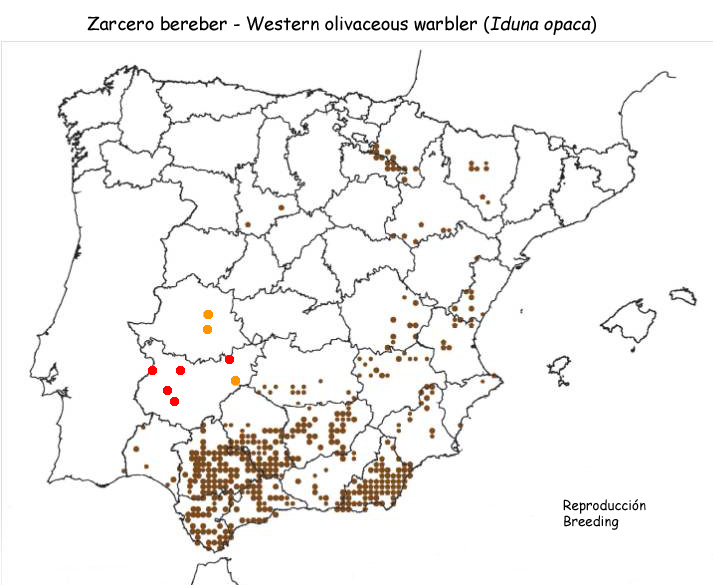
The first records in Extremadura of Western Olivaceous Warbler go back to 1985 and 1990, being mist-netted birds for ringing by Adenex. Subsequently in the fieldwork for the Spanish breeding birds Atlas (1998 – 2002) the species was not detected at all, thus showing a complete blank for Extremadura. This map is shown below, to which later records are shown (see the list at the end of the posting): in red are localities with certain or probable breeding and in orange are records of passage or where the record may be doubtful. In May and June 2013, Western Olivaceous Warblers were seen regularly at two locations on the Guadiana river: in Mérida (two males singing in riverine woodland dominated by ash) and in Badajoz (at least three males in a stretch dominated by willows). As can be seen in the list, these two locations stand out in terms of number of observations, without doubt because of the number of birdwatchers based there. Therefore, it is highly likely that the species breeds more widely on other stretches of the Guadiana and its tributaries. As can be seen in the map, the Western Olivacous Warbler is distributed throughout Andalucia, and there are also smaller populations in the east of the peninsula, especially on the Ebro and the edges of Ciudad Real and Valladolid.

Consulting ringing data provided by SEO/BirdLife, there are five sites where the species has been apparently trapped in Extremadura: four on the Guadiana (mainly Mérida) and the other in Cáceres province (Coria or thereabouts). However, this information is very confused. The data suggest that more than 8,000 birds have been ringed in Spain, the majority between 2009 and 2010 (when more than 1,600 captures took place (see figure below). Taking into account that in the Atlas for Spain the total population is estimated at 4,000 pairs and that this figure is reduced to only 1,000 pairs in the Spanish Red Data Book for birds, the figures given for trapped birds are wildly disproportionate. Numerous birds are claimed to have been trapped in Madrid province, where Western Olivaceous Warbler does not breed. Therefore, it is best to be sceptical about this information.


OBSERVATIONS OF WESTERN OLIVACEOUS WARBLER IN EXTREMADURA 
(Sources: Bird Reports 1998 – 2008 and monthy blog summaries)

- One ringed by Adenex in 1985 (José Antonio Román, 2011).
- One ringed by Adenex in 1990 (J. A. Román, 2011).
- Spring 1995: one seen at Valuengo reservoir in oleander and tamarisk (Emilio Costillo).
- One drinking at Fuente de Francés, Monfragüe (CC) on 20/08/1999 (E. Streich y Marc Gálvez).
- Two by River Guadiana, Mérida on 12/07/2004 (Francis Prieto).

- One by River Almonte, Trujillo on 23/04/2008 (Jesús Porras).
- One by River Gargáligas, Vegas Altas on 21/05/2008 (I. Castelao).
- One at Monfragüe on 28/05/2008 and three at Cabeza del Buey on 30/05/2008 (E. Bonavia).
- An adult feeding a fledged young by the Ribera de Nogales stream, between Torre de Miguel Sesmero and Entrín on 29/06/08 (M. Gálvez). First certain breeding record.
- Two by Guadiana River, Badajoz on 26/06/2009 (M. Gálvez y José Guerra).
- Two at Puente Viejo, Badajoz on 30/08/2010 (Juan Carlos Paniagua).
- Two at Montijo reservoir, Mérida (BA) on 30/05/2012 (Francisco Montaño, Elvira del Viejo y A. Ruiz).
- A juvenile of the year trapped for ringing at the Azud de Badajoz on 14/07/2012; could have fledged from the area (Ángel Tomas Mejías).

- A male singing by Guadiana River, Mérida (BA) at least from 13/05/2013 to 30/06/13 (Sergio Pérez Gil, Lorenzo Alcántara, M. Gálvez, Jesús Solana, César Clemente y Manuel García).
- At least three singing males between 27/05/2013 to 16/06/13 at the Azud de la Granadilla, Badajoz  (Juan Carlos Paniagua, Atanasio Fernández, Sergio Mayordomo y Eva Palacios)
- Unpublished information, for which there are no available details, of Western Olivaceous Warbler breeding in at least five locations in Badajoz province (Fergus Crystal Robertson).

Translated by Martin Kelsey. 
reade more... Résuméabuiyad

Catch up

So another month comes to an end.

The small Swallow project i do around the farms in the Maughold area is coming to an end.
71 chicks ringed so far with a few more nests to ring. I might do a second brood check. 
but could be busy with other stuff.

16 adult Arctic Terns have been caught and some nice data is being collected. Two birds were ringed as chicks back in 1999 and 2001 and are now back breeding on that same beach. 1 Chick this year so far has been ringed

Our on going study of the Little Terns is again producing some good records with birds being ringed as chicks in Kilcooli, Co Wicklow  Ireland. Great Yarmouth, Foulney island Barrow-in-Furness and  Crimdon Park near Hartlipool all now nesting at our small colony.

The Gt Yarmouth bird was 13 years old when caught last year and 2 chicks ringed 12 years ago at our colony are nesting there still.

So far this year 10 Adult Little Tern have been caught and 7 chicks ringed.

A nice morning spend at the Dhoon site on Thursday with 21 Siskin being ringed 18 of them 3j birds. Also 3 Lesser Redpoll in with them. 117 siskin now ringed at this new site.

Some great friends came to stay on Thursday for their annual visit. Kane and Gillian.

So a busy morning on Friday checking one of the Cormorant colonies. 
15 Cormorant chicks colour ringed with birds still on eggs and very small young.

Cormorant colour ring

Gillian Kev and Kane


Also 5 Greater Black Back Gull Chicks colour ringed and 4 Common Gull chicks
Kane and GBBG

Common Gull


5 Sparrowhawk chicks ringed


Saturday we met up with Louise the warden and went to check on the Tern colonies.

Little Tern

Little Tern chicks
Gillian ringing Arctic Tern
After the Terns and a Ring Plover chick were ringed we moved off to a Hen Harrier nest.

The nest we had been watching had 5 eggs 3 weeks ago, when we went in to it only one female Harrier chick was in it with 2 addled eggs. The weather over the last two weekends has been very wet and foggy maybe this is the reason for such a low return.

Hen Harrier chick
From the Harrier we moved on to a Spotted Flycatcher nest where 5 adorable chicks sat looking at us

Spotted Flycatchers

The last visit was to a Kestrel nest where 5 chicks were ringed.

A Big Thanks to everyone who help with the above efforts, you know who you are, Massive thanks to Chis Wade from Island Aggregates 
Louise Samson from Defa,  and all the people who have giving us permission to ring on their land 


A great two days spent with 2 great people who are welcome anytime.


we did still  manage to catch when we got home, 3 Herring Gulls colour ringed. Before the Gin came out

reade more... Résuméabuiyad

IBERIAN CHIFFCHAFF RINGED IN EXTREMADURA


Author: Hugo J. Gómez-Tejedor Alonso (GIA-Extremadura). 
Translated by Martin Kelsey.

During a day’s ringing as part of the PASAR scheme by GIA-Extremadura, what could be the first breeding Iberian Chiffchaff (Phylloscopus ibericus) in Extremadura was caught. The bird was mistnetted on 5th June 2013 at the PASER P-5005 station at La Lapa, in the southern-central part of Badajoz province, in shady-slope habitat dominated by woodland of cork oak, holm oak, honeysuckle, strawberry trees and other shrubs. The only regular breeding area for this species in Extremadura is in the south of Badjaoz province, in the Sierra de Tentudia. This new location is a northern extension of the range of the species in the province.

The trapped bird was an adult male, with a marked cloacal protuberance and characteristic plumage of bright green back with yellowish tinges and emargination on the sixth primary, and the second primary the same length as the seventh. The wing length, based on maximum chord was 55.5 mm, using the third primary 44 mm and the tarsus was 19.26 mm. These biometrics, along with weight of 7.4 g are within the species ranges based on observations in Doñana and Cádiz. The closest records to this site are at Burguillos del Cerro. There a male was singing on 21/03/2006 and on 02/04/2006 (Francisco Montaño com. pers.), although on date those records could have been a passage bird instead of a local breeder.

Given the recent split of Iberian Chiffchaff from Common Chiffchaff (Phylloscopus collybita), the breeding range of the former is not well known in the Iberian Peninsula in general and in Extremadura in particular. Thus this note advances our knowledge of the species in our region.

Literature

- Balmori, A.; Cuesta, M.A. & Caballero, J.M. 2002. Distribución de los mosquiteros ibéricos (Phylloscopus breehmi) y europeo (Phylloscopus collybita) en los bosques de ribera de Castilla y León (España). Ardeola 49: 19-27.
- Baker K.1997. Warblers of Europe, Asia and North Africa. Helm. London.
- Barros, D. & Ríos, D. 2002. Guía de aves del Estrecho de Gibraltar. Ornitur S.L. Cádiz.
- Bermejo, A. 2006. Programa PASER: más de diez años trabajando para la conservación de las aves. Revista de Anillamiento 13-14: 2-26.
- Onrubia, A.;  Arroyo, J.L.; Andrés, T.; Gómez, J.; Unamuno, J.M. & Zufiaur, F.   2003. El mosquitero ibérico (Phylloscopus ibericus): identificación, biometría y apuntes sobre su migratología. Revista de Anillamiento 12: 18-29 

- Prieta, J. & Mayordomo, S.  2011. Aves de Extremadura, vol. 4. SEO-Cáceres, Plasencia.
- Salomón, M.; Voisin, J.F. & Bried, J. (2003). On the taxonomic status and denomination of the Iberian Chiffchaffs. Ibis 145: 87-89.
- Svensson, L. 1996. Guía para la identificación de los passeriformes europeos. SEO/Birdlife. Madrid.
- Telleria, J.L.; Asensio, B. & Díaz, M. 1999. Aves Ibéricas vol. II.  Passeriformes.
reade more... Résuméabuiyad

bird binoculars

To have the best out of bird watching you want decent bird binoculars. Birding can be somewhat ruined if you can't see bird binoculars the birds you are attempting to view with the degree of clarity and detail that you should. An unclear image means it is hard to tell the difference between one bird plus the next with some bird binoculars probably not helping you see much more than you will observe with the naked vision.

The quality of the optics in bird binoculars is exceptionally important if you wish to ensure maximum enjoyment out of your sport. In recent years the price tag on bird binoculars with good quality lenses has decreased sufficient reason for the wider availability of affordable quality binoculars has come a higher bird binoculars interest in bird watching.

There are some fantastic 8x32 and 8x42 bird binoculars around plus the Canon 12x36 IS binoculars are usually increasing in popularity as they offer the option of high powered binos without worrying about distortion that is experienced when high magnification no IS binoculars are portable.

At the top end on the market you have many serious bird binoculars including the Swarovski 8. 5x42 EL's or perhaps the Leica Ultravid thirty-two or 42 series. Some critics say them to aren't worth the cost (at £1, 000 +) but in reality it truly is a matter of opinion and it also does depend on how serious that you are about birding. As you head up the price range the added in benefit between bird binoculars begins to decrease so it just depends upon what value you place on certain extra features that bird binoculars make binos particularly special.

If you are searching for the top of the range investigate Leica Ultravid 8x42. Your weight and balance is superb, you bird binoculars could use these all night and they would still really feel in your hand. Alternatives quality of the optics, just try them and pay attention to! If you can afford it they're well worth a search.

If you want something a little cheaper then the Pentax DCF SP 8x43 or perhaps 8x32 make excellent chook binoculars. They come with phase-coated bird binoculars prisms along with fully multi-coated lenses using a sophisticated optical design, they're waterproof, nitrogen filled and sealed and possess a water repellent coating on all exposed contacts. A great buy at below £400.

Steiner make some brilliant bird binoculars including the perfectly balanced 8x44 Steiner Discovery which includes a comfort bird binoculars balance system, high definition optics, Steiner Nano The environmental protection and fast near focus. Or, if you want something smaller and cheaper then this Steiner WildLife Pro is surely an immensely popular bird binocular, particularly the mid-size 8x30 that features a wide field of view turning it into ideal for following moving objects.

Image stabilizing is a great feature to have for most applications. Some find the Cannon 10x42 IS binoculars alternatively heavy at1030g with many birders opting for the more powerful yet lighter and cheaper option on the 12x36's (660g but not bird binoculars waterproof plus the don't have the L series lenses which have been featured in the 10x42's).
bird binoculars

Another great bird binocular is the Nikon High Grade, along with advanced lens and prism structure which produces exceptionally clear, sharp images and fantastic colour reproduction. Every model is waterproof and it is made with environmentally warm and friendly materials. Prices start at around £300 as much as around £1, 000 (available inside both full size along with compact binoculars).
reade more... Résuméabuiyad

bird bath heater

Solar power is probably just about the most important alternative energy types of the century. It has everything bird bath heater that we need to replace our current method to obtain power, which is also the crucial reason why the planet's condition can be degrading. We need to be familiar with this fact because in case we don't act currently, who knows what next week would bring. We probably won't even have a "tomorrow" to manage if we keep on doing might know about are doing right bird bath heater currently. Fortunately, lots of folks, groups, and companies are usually planning along the same lines even as are. They also felt the urgency to create remedies to find applications because of this alternative bird bath heater power source. One of those applications is solar driven device. An example could be the Solar Powered Bird Bath tub heater, which is at present spoiling the birds. (This is in reality a good thing)

So what is this bird bath heater heater? It's the same you which you use to have in your backyard. It gives anyone the fun and entertainment bird bath heater of watching wild chickens gather around it, merrily dipping inside the water. But like individuals, they also hate cold, freezing water. That's exactly why you need a heating unit. Usually, a heater can become powered by regular electricity and that is what we are seeking to avoid. The solution is by using a heater that is bird bath heater powered by power from the sun. That is what it's about. You don't have to stress about electricity cost. Now you can bird bath heater supply birds with warm bath water that they can could use 4 seasons, thanks to this product.
bird bath heater

How would you bird bath heater push the button? There are two popular ways to push the button. First, you can use the one that already has an incorporated screen. This means that the screen itself is part of the bath or is integrated by using it. The other setup is powering a normal one with solar power coming from a solar panel bird bath heater that is actually installed somewhere. Whether which type of setup need to be used heavily depends on where you will definitely place it. It is essential that you know the spot through which you would install the bird bath. If the bird bath is bird bath heater someplace sunny, you could make use of the one with solar panels integrated by using it. However, if your location is actually somewhat shady and sunlight is difficult for getting by, you should make use of the other setup type bird bath heater.
reade more... Résuméabuiyad

LANNER FALCON NEAR TRUJILLO

On the morning of 10th June 2013, Martin Kelsey, accompanied by two clients, visited the plains of the Los Cerralbos near Trujillo (Cáceres) and had the good fortune to observe and photograph a subadult Lanner Falcon (Falco biarmicus),identified as of the North African subspecies (erlangeri). [Read more in the personal blog of Martin Kelsey]. This falcon breeds in Africa, south-west Asia and south-east Europe, with the nearest populations in Morocco and Italy, especially Sicily. Breeding has taken place in Spain in the recent past, with proven records (eggs and nests) in Doñana up to the close of the 19th Century, and recent isolated breeding records in the mid 20th Century in Andalucia (Doñana 1954; Almeria) and the Balearics (breeding attempt in 1971).


Owing to its use in falconry and the presence of hybrid falcons of various crosses, its identification is not straightforward and sightings are often unconfirmed because of small details (up to 2003 in Spain there were seven accepted records and 18 rejected ones). In the Iberian Peninsula, there have been more than 30 records in the area of the Straits of Gibraltar, especially during migration (March – May and August – October), which confirms a regular movement to and from Africa. In France and Cataluña there are several dozen records, the majority being in autumn and winter, between September and February (De Juan 2006). As far as we know this is the fourth sighting of Lanner Falcon in Extremadura. The three that provide information of age are all of immature birds, suggesting a dispersal of non-adults from the north of Africa. There have been two records in June, one in August and the other in January; three of these records have been in open farmland steppe country.

The first record in Extremadura was also the first officially accepted record in Spain. It is a confusing record which gave rise to the possibility of breeding. There were many sightings of the same bird, but only one was accepted by the Rarities Committee: Cabeza de Buey (La Serena, Badajoz) on 11 th June 1992 (R. Munheim). The first Extremadura Bird Report included two other records from the same location which were not submitted to the Committee. A bird was photographed perched on a rocky outcrop on 4th May 1992 (Manuel Calderon and two Swiss ornithologists), which was surely the same bird seen a month later by Munheim. Three years later, on 8th May 1997, a bird was seen perched in a cutting (José Enrique Capilla). Over at least three years, there was various unpublished sightings by both Spanish and foreign observers about the presence of one or two Lanner Falcons at Cabeza del Buey, in one case suggesting breeding. Years later, all we can say is that there was one confirmed sighting and the rest remain an unsolved mystery.

The second confirmed record was an immature with features of the subspecies F. b. erlangeri photographed 15 km east of Cáceres on 24th August 2007 (R. Tonel, Ardeola 56:321). And the third, pending confirmation, is also from this year (2013) with a second year bird seen in flight over the Camino de las Huertas, Plasencia (Cáceres), on 3 rd January 2013 (Sergio Mayordomo and Ricardo Montero).
 
De Juana, E. 2006. Aves raras de España. Lynx Edicions. Barcelona.

Translated by Martin Kelsey.
    On the morning of 10th June 2013, Martin Kelsey, accompanied by two clients, visited the plains of the Los Cerralbos near Trujillo (Cáceres) and had the good fortune to observe and photograph a subadult Lanner Falcon (Falco biarmicus),identified as of the North African subspecies (erlangeri). [Read more in the personal blog of Martin Kelsey]. This falcon breeds in Africa, south-west Asia and south-east Europe, with the nearest populations in Morocco and Italy, especially Sicily. Breeding has taken place in Spain in the recent past, with proven records (eggs and nests) in Doñana up to the close of the 19th Century, and recent isolated breeding records in the mid 20th Century in Andalucia (Doñana 1954; Almeria) and the Balearics (breeding attempt in 1971).


    Owing to its use in falconry and the presence of hybrid falcons of various crosses, its identification is not straightforward and sightings are often unconfirmed because of small details (up to 2003 in Spain there were seven accepted records and 18 rejected ones). In the Iberian Peninsula, there have been more than 30 records in the area of the Straits of Gibraltar, especially during migration (March – May and August – October), which confirms a regular movement to and from Africa. In France and Cataluña there are several dozen records, the majority being in autumn and winter, between September and February (De Juan 2006). As far as we know this is the fourth sighting of Lanner Falcon in Extremadura. The three that provide information of age are all of immature birds, suggesting a dispersal of non-adults from the north of Africa. There have been two records in June, one in August and the other in January; three of these records have been in open farmland steppe country.

    The first record in Extremadura was also the first officially accepted record in Spain. It is a confusing record which gave rise to the possibility of breeding. There were many sightings of the same bird, but only one was accepted by the Rarities Committee: Cabeza de Buey (La Serena, Badajoz) on 11 th June 1992 (R. Munheim). The first Extremadura Bird Report included two other records from the same location which were not submitted to the Committee. A bird was photographed perched on a rocky outcrop on 4th May 1992 (Manuel Calderon and two Swiss ornithologists), which was surely the same bird seen a month later by Munheim. Three years later, on 8th May 1997, a bird was seen perched in a cutting (José Enrique Capilla). Over at least three years, there was various unpublished sightings by both Spanish and foreign observers about the presence of one or two Lanner Falcons at Cabeza del Buey, in one case suggesting breeding. Years later, all we can say is that there was one confirmed sighting and the rest remain an unsolved mystery.

    The second confirmed record was an immature with features of the subspecies F. b. erlangeri photographed 15 km east of Cáceres on 24th August 2007 (R. Tonel, Ardeola 56:321). And the third, pending confirmation, is also from this year (2013) with a second year bird seen in flight over the Camino de las Huertas, Plasencia (Cáceres), on 3 rd January 2013 (Sergio Mayordomo and Ricardo Montero).
     
    De Juana, E. 2006. Aves raras de España. Lynx Edicions. Barcelona.

    Translated by Martin Kelsey.
      reade more... Résuméabuiyad